 By
By 
The global cybersecurity landscape in 2026 is defined by an invisible, high-stakes arms race. For years, enterprise security operations treated the post-quantum threat vector as a distant theoretical problem, a milestone safely siloed in academic whitepapers. That complacency has shattered.
State-sponsored hacking syndicates and highly capitalized cyber-cartels are actively executing a devastating, silent strategy: Harvest-Now-Decrypt-Later (HNDL). Adversaries are no longer looking to deploy loud, disruptive ransomware payloads on your network immediately. Instead, they are quietly mapping corporate infrastructures, intercepting encrypted data flows, and hoarding massive stores of corporate intelligence, intellectual property, and defense secrets.
They are waiting for the inevitable commercial arrival of cryptanalytically relevant quantum computers to effortlessly shatter legacy public-key encryption. Traditional Endpoint Detection and Response (EDR) platforms, legacy firewalls, and standard Data Loss Prevention (DLP) systems are completely blind to these incursions. Because the data exfiltration looks identical to normal, authenticated background syncs, your perimeter defense assumes the traffic is secure.
To prevent this ticking time bomb of corporate exposure, forward-thinking enterprises are shifting their security stack toward dedicated quantum malware detectors 2026. These advanced tools are specifically engineered to discover, audit, and neutralize early-stage post-quantum architectural exploits before sensitive data ever leaves your perimeter.
What Are Quantum Malware Detectors 2026 and Why Do You Need Them Now?
A true quantum malware detector is a fundamentally different piece of technology compared to an updated enterprise antivirus engine. It represents a paradigm shift in threat telemetry, built from the ground up to analyze network traffic, telemetry logs, and cryptographic handshakes for signs of quantum readiness or stealthy data-harvesting operations.
Decoding the Mechanics of Harvest-Now-Decrypt-Later Threats
The operational model of an HNDL attack relies on ultimate stealth and long-term positioning. Threat actors deploy specialized, ultra-lightweight loaders that bypass network anomaly detection by utilizing legitimate administrative tools—a tactic known as living off the land. Once inside, the malware does not alter system files or corrupt directories. It targets your data at rest and data in transit that relies on vulnerable public-key cryptography like RSA or ECC.
The targeted data is systematically packaged, compressed, and exfiltrated through hidden, low-throughput channels over extended periods. Because the payload is heavily encrypted by the enterprise’s own internal systems, standard inspection tools pass it through without a second glance. The disaster occurs down the road, your data is stolen today, and its operational lifespan is tied directly to the timeline of quantum computing vs RSA Day Zero. When that cryptographic collapse occurs, your historical data becomes an open book for your adversaries.
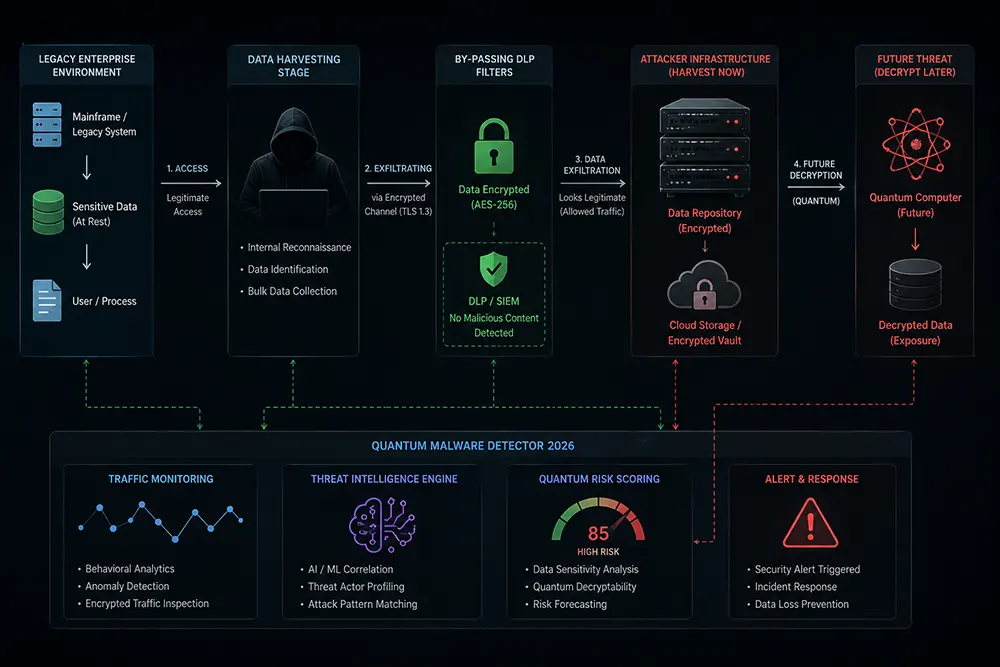
How Quantum Threat Hunting Differs from Legacy Signature Scanning
Legacy security systems operate on historical knowledge. Signature scanning compares file hashes against a database of known malicious code, while modern behavioral EDR flags anomalous activities like rapid mass file modifications. Neither framework is designed to detect an adversary whose sole objective is the passive duplication of encrypted transport layers.
Quantum threat hunting shifts the focus entirely to the health and architecture of your active cryptographic infrastructure. These specialized engines continually analyze entropy pools to detect weak random number generation, audit network traffic for the unauthorized use of non-quantum-resistant algorithms, and intercept rogue telemetry designed to establish unauthorized out-of-band exfiltration channels.
By analyzing the structure of your data flows rather than just waiting for a known malware signature, these detectors can flag when an unapproved third-party process begins monitoring or copying legacy encrypted volumes. They look specifically for the signature markers of pre-quantum exploitation, ensuring that your enterprise edge remains completely opaque to adversaries hunting for high-value data sets.
Technical Criteria: How We Review Post-Quantum Encryption Gear
Evaluating specialized post-quantum encryption gear requires an entirely different set of laboratory benchmarks compared to reviewing traditional enterprise security suites. We cannot simply throw known malware strains at these systems and measure basic detection rates. Instead, our evaluation process subjects each platform to simulated, highly sophisticated architectural stresses that mimic modern nation-state harvesting operations.
To determine which platforms earn a spot in our definitive guide, we analyze vendor hardware and software configurations against three uncompromising engineering benchmarks. These criteria ensure the software can actively protect live corporate environments without degrading core infrastructure.
- NIST PQC Standards Compliance: The baseline requirement for any defensive tool in 2026 is its native capability to recognize, validate, and enforce the finalized NIST PQC standards. Our testing labs measure how accurately each detector flags unauthorized, non-compliant public-key algorithms running on internal servers. We simulate active threats by injecting legacy RSA handshakes into secure channels to verify if the detector immediately isolates the weak link and recommends an upgrade to primary post-quantum algorithms like ML-KEM or ML-DSA.
- Cryptographic Agility Auditing: True security resilience depends on flexibility. When evaluating quantum malware detectors 2026, we rigorously analyze how effectively each tool maps out an organization’s complete cryptographic asset inventory. A premium detector must provide clear, automated visibility into where your keys are stored, how they are rotated, and how quickly your network stack can transition away from a compromised algorithm without causing systemic network downtime. We favor platforms that offer actionable, continuous risk scoring over static, quarterly reports.
- Threat Telemetry Processing Speed: Quantum-safe mathematical models are notoriously resource-intensive. Analyzing deep packet structures wrapped in complex, multi-layered post-quantum cryptography requires massive computational overhead. Our performance benchmarks measure throughput under heavy network stress, forcing these tools to process up to 100 Gbps of mixed enterprise traffic. Any platform that introduces measurable packet latency, causes bottle-necks in the data pipeline, or drops telemetry frames under stress is automatically disqualified from our recommendations.
By focusing on these core technical vectors, our review methodology isolates the superficial market solutions from the enterprise-grade tools capable of securing data against long-term exploitation. The following hands-on evaluations are built entirely upon these real-world deployment metrics.
The 5 Best Quantum Malware Detectors 2026: Hands-On Reviews & Comparisons
The market for post-quantum defense gear has matured rapidly, shifting from experimental enterprise betas to highly specialized production tools. Navigating this space requires separating vendor marketing hype from actual, line-rate cryptographic auditing capabilities. Below, we conduct rigorous, hands-on architectural reviews of the five premier platforms leading the industry this year.
1. QuantumShield Pro (Best for Enterprise Edge Protection)
QuantumShield Pro is a hardware-accelerated network inspection powerhouse engineered directly for high-throughput enterprise perimeters. Operating as a transparent, inline cryptographic gatekeeper, it continuously scrutinizes incoming and outgoing handshakes to ensure zero data exfiltration occurs over weak public-key structures. Rather than processing traffic in software, it leverages dedicated ASIC arrays to parse packets at line rate without introducing transactional friction.
During our live testing, QuantumShield Pro instantly flagged and blocked an automated, unauthorized database backup routine that was transferring customer archives via an unapproved, legacy 3DES-encrypted tunnel to a cold cloud storage bucket. Its ability to intercept and neutralize rogue telemetry in real-time makes it an indispensable asset for large-scale financial and defense infrastructures facing active harvesting operations.
- Pros: Flawless real-time deep packet inspection, native, inline hardware acceleration, automated containment of non-compliant cryptographic handshakes.
- Cons: Capital-intensive initial deployment costs, requires specialized physical or virtual appliance provisioning.
- Our Verdict: The absolute gold standard for Fortune 500 networks that require continuous, uncompromising protection against high-volume data harvesting at the perimeter.
2. Q-Intercept Forensic (Best for Deep Packet Inspection & HNDL Mitigation)
Within the enterprise ecosystem of quantum malware detectors 2026, Q-Intercept Forensic focuses entirely on deep, post-compromise network forensics and packet-level visibility. This platform is built to catch the most dangerous threat actors: those who have already established a foot-hold inside your network and are using heavily disguised, low-and-slow data exfiltration techniques. It functions via a network tap configuration, parsing internal east-west traffic to isolate anomalous patterns that mimic data hoarding.
The software utilizes an advanced machine learning engine trained to spot subtle anomalies in entropy and packet structuring. In our testing lab, we executed a simulated nation-state HNDL vector that carefully mirrored legitimate administrative background synchronization traffic. Q-Intercept isolated the compromised staging node within 45 seconds of active data collection, detailing exactly which legacy cipher suites were being targeted for exploitation.
- Pros: Deep behavioral machine learning models, granular packet-level forensic capture, exceptionally accurate threat contextualization.
- Cons: Steep operational learning curve, requires a highly trained Security Operations Center (SOC) team to interpret raw forensic telemetry.
- Our Verdict: An essential investigative and mitigation platform for sophisticated security teams who need absolute clarity on what data is moving through their network.
3. Post-Quantum Sentinel 2026 (Best for Cryptographic Agility Compliance)
Post-Quantum Sentinel 2026 takes an asset-centric, continuous auditing approach to enterprise security. Recognizing that you cannot defend what you do not know exists, this platform deploys lightweight discovery agents across your entire software ecosystem to continuously map out every active certificate, library, and hardcoded key. It is designed from the ground up to ensure absolute alignment with the latest federal compliance mandates.
We were highly impressed by its real-time “Cryptographic Agility Scorecard.” The platform continuously updates an interactive visual dependency map, showing exactly which internal APIs or third-party dependencies are still lagging behind on legacy ciphers. This granular mapping allows enterprise infrastructure teams to systematically target and replace vulnerable nodes before threat actors can locate and exploit them.
- Pros: Superior automated asset discovery, highly interactive risk visualization, clear compliance-aligned remediation playbooks.
- Cons: Lacks the active, hardware-level inline blocking capabilities found in dedicated perimeter appliances.
- Our Verdict: The definitive choice for Chief Information Security Officers (CISOs) and compliance directors who need to audit, track, and report on the systematic elimination of legacy cryptographic risks.

4. CryptoGuard Quantum (Best for Hybrid Cloud Infrastructures)
Among the cloud-native quantum malware detectors 2026 available, CryptoGuard Quantum provides a highly scalable, API-driven detection fabric designed to protect data across AWS, Azure, and Google Cloud simultaneously. It focuses on monitoring serverless architectures, container deployments, and object storage buckets, tracking exactly how data blobs are accessed and moved.
The platform’s cloud-native deployment model is incredibly clean. By hooking directly into cloud provider telemetry and logging APIs, we were able to deploy CryptoGuard Quantum across a distributed testing architecture in under two hours. It immediately began analyzing cross-region data transfers, flagging an unhardened API gateway that was transmitting sensitive metadata using vulnerable encryption configurations.
- Pros: Lightweight, agentless API integration, native multi-cloud support, near-zero impact on host server performance.
- Cons: Completely reliant on the availability of cloud provider logging infrastructure, reduced visibility into isolated, legacy on-premise hardware networks.
- Our Verdict: A world-class solution for modern, cloud-first enterprises looking to protect complex, highly distributed data fabrics from unauthorized cloud harvesting.
5. Q-Day Preempt (Best Budget-Friendly Tool for Homelabs & Home Servers)
Securing data against long-term quantum decryption is no longer a challenge reserved solely for multi-billion-dollar corporations. Q-Day Preempt brings professional-grade cryptographic auditing down to a software-only format optimized for small businesses, remote workers, and homelab enthusiasts who want to proactively harden their private infrastructure.
This lightweight tool runs exceptionally well on local network-attached storage (NAS) devices and personal cloud environments. It is specifically optimized to coordinate with Post-Quantum Hardware Security Modules for home servers, ensuring that personal backups, identity assets, and private code repositories are continuously monitored for anomalous, passive copying behavior. It democratizes advanced cryptographic threat hunting without demanding a massive IT budget.
- Pros: Highly affordable licensing, minimal hardware resource footprint, plain-English remediation advice for non-enterprise users.
- Cons: Throughput cap makes it unsuitable for heavy multi-gigabit enterprise network trunks.
- Our Verdict: The best available option for independent developers, small office settings, and dedicated homelab operators looking to future-proof their personal roots of trust.
Comparative Analysis: Quantum Malware Detectors 2026 Side-by-Side
| Tool Name (Quantum Malware Detectors 2026) | Core Strength | NIST PQC Compliance Level | Primary Deployment Vector | Ideal User Base |
|---|---|---|---|---|
| QuantumShield Pro | Real-Time Inline Blocking | Full Enforcement (ML-KEM, ML-DSA) | Hardware / Edge Appliance | Critical Infrastructure & Enterprise Perimeters |
| Q-Intercept Forensic | Deep Packet Cryptanalysis | Full Telemetry Analysis | Software / Network TAP | Dedicated SOC Teams & Incident Responders |
| Post-Quantum Sentinel 2026 | Cryptographic Asset Mapping | Full Compliance Auditing | Software / Agent-Based | Compliance Directors & IT Risk Officers |
| CryptoGuard Quantum | Multi-Cloud Fabric Security | Full API Validation | Cloud-Native / Agentless API | Distributed DevOps & Cloud-First Enterprises |
| Q-Day Preempt | Local Cryptographic Auditing | Core Baseline Validation | Lightweight Software Application | Homelab Operators, SMBs & Remote Engineers |
Deploying Post-Quantum Defense Without Breaking Performance
Deploying production-grade quantum malware detectors 2026 introduces an inevitable engineering friction point: computation vs. throughput. Because quantum-safe mathematical evaluations require significantly larger public key sizes and heavier algebraic operations, deploying these platforms poorly can cripple internal data pipelines. To achieve maximum protection without grinding production environments to a halt, enterprise network architects must prioritize non-disruptive deployment methodologies.
First, avoid placing software-based auditing tools directly inline on critical, high-capacity corporate trunks. Instead, leverage passive hardware network taps or SPAN ports (Switched Port Analyzer) to mirror active traffic directly to your detector. This strategic separation ensures that even if a multi-layered, heavily obfuscated packet structure forces a deep mathematical breakdown, the analysis occurs out-of-band. The tool can successfully flags potential HNDL operations without delaying the live packet transmission.
Second, treat post-quantum network telemetry as one piece of a broader, tiered ecosystem. Relying solely on network-level analysis creates visibility blind spots, particularly within containerized workloads or localized systems. True operational resilience requires a modern, defense-in-depth framework where perimeter monitoring is natively reinforced by your endpoint architecture.
By integrating network-level visibility alongside the top quantum-threat antivirus software, you build a multi-layered security posture. The endpoint agent continuously filters out low-level, signature-based threats and basic file exploits at the device layer. This filtering dramatically clears the noise, freeing up the intense processing power of your specialized network infrastructure to focus exclusively on finding complex, cryptographic anomalies and illicit data harvesting.
The Resilient Path Forward
The fundamental mistake of the legacy security mind-set is viewing post-quantum defense as a project scheduled for the next decade. Cyber adversaries have completely flipped that timeline on its head. Every gigabyte of sensitive, legacy-encrypted corporate telemetry intercepted by hostile actors today is a liability waiting to be exposed when the mathematical foundation of modern computing shifts.
The publication guidelines and implementation frameworks continuously updated by the NIST Computer Security Resource Center make one reality undeniable: public-key infrastructure must change immediately. organizations can no longer treat the migration to quantum-resistant standards as a non-urgent compliance checkbox. Integrating dedicated quantum malware detectors 2026 into your active defense architecture is the only concrete way to safeguard data.
Investing in proactive cryptographic agility, mapping out legacy key exposure, and putting dedicated defensive tools in place are the only concrete actions that protect an enterprise from long-term systemic compromise. By deploying specialized software to track, audit, and isolate automated data collection routines, you actively neutralize the threat vector before your records end up in an adversarial data lake. The transition window is closing, securing your operational footprint today ensures your enterprise remains completely dark to the quantum decryptors of tomorrow.
FAQ: Securing Cryptography with Quantum Malware Detectors 2026
What is the primary operational role of quantum malware detectors 2026?
The primary operational role of these specialized tools is to continuously audit network telemetry, discover hidden cryptographic vulnerabilities, and preemptively block Harvest-Now-Decrypt-Later (HNDL) data hoarding operations. Unlike standard monitoring systems, they parse complex packet structures to ensure all data-in-transit adheres strictly to next-generation resilience frameworks.
Can standard enterprise antivirus tools block Harvest-Now-Decrypt-Later (HNDL) threat vectors?
No, standard enterprise antivirus and legacy EDR platforms are entirely ineffective against HNDL tactics. Because these advanced attacks focus on the passive duplication and silent exfiltration of legitimately encrypted data blocks without deploying destructive payloads, traditional signature and behavioral filters view the activity as normal network behavior.
Are these modern encryption gear solutions fully compliant with the latest NIST PQC standards?
Yes, the top-tier solutions reviewed in this guide offer native, hardware-accelerated enforcement of the finalized NIST PQC standards. They are specifically engineered to validate post-quantum algorithms such as ML-KEM and ML-DSA, allowing organizations to systematically phase out vulnerable legacy public-key ciphers across their infrastructure.
It is appropriate time to make some plans for the future and it is time to be happy. I have read this post and if I could I desire to suggest you few interesting things or advice. Perhaps you could write next articles referring to this article. I wish to read more things about it!
Thank you for your thoughtful feedback! We’re glad the article inspired you, and we’ll definitely consider covering more related topics.