 By
By 
The threat landscape for home server enthusiasts has shifted dramatically over the last year. Hackers are currently executing “Harvest Now, Decrypt Later” attacks at an industrial scale. They are exfiltrating encrypted family archives, private keys, and personal cloud data today, banking on the fact that a cryptographically relevant quantum computer will crack that legacy encryption tomorrow. If your sensitive data relies on standard 2048-bit RSA, your privacy is already on a countdown to exposure.
A Post-Quantum HSM represents the ultimate tactical upgrade for the “OnlineShieldHub” community. Moving beyond standard hardware, these modules support next-generation algorithms like CRYSTALS-Kyber and Dilithium. By offloading your most critical cryptographic operations to specialized hardware, you ensure that even if your server’s primary OS is compromised, your core identity remains physically isolated. Our Tactical Armory mission is clear: we are evaluating the first wave of consumer-accessible secure elements that can withstand a quantum-level assault.
The Anatomy of a Post-Quantum Root of Trust
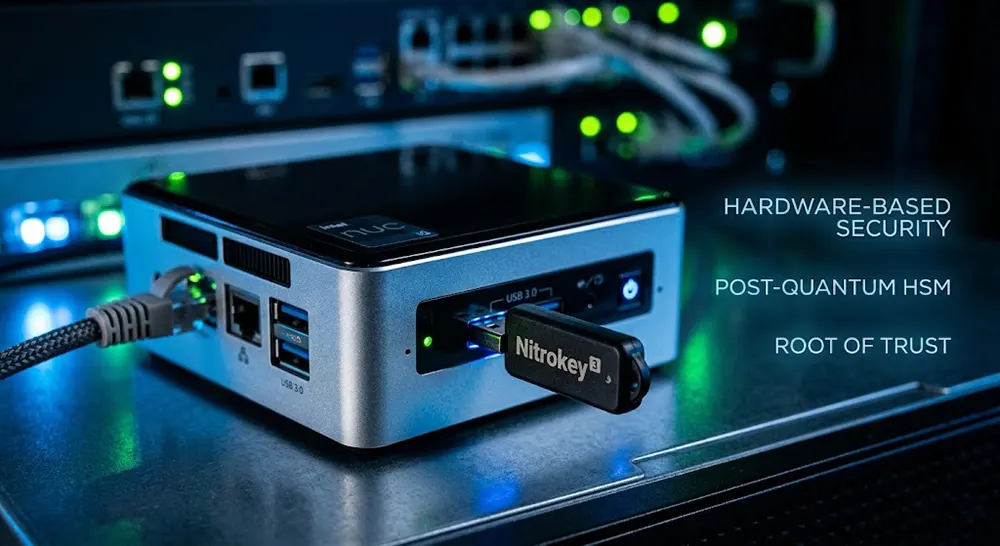
To understand why a Post-Quantum HSM is vital, we must first look at the mechanics of hardware-backed security. A Root of Trust (RoT) is the foundational source that can always be trusted within a computer system. In a home lab environment, relying on software-based keys is a recipe for disaster.
Secure Element (SE) vs. External HSM
There is a common misconception that a standard motherboard TPM (Trusted Platform Module) is sufficient. While a TPM is a form of Secure Element, it is often “fixed” in its capabilities. An external Post-Quantum HSM, however, is a dedicated module designed for high-assurance key management and cryptographic offloading. It provides a physical barrier: your private keys are generated inside the chip and never leave it.
Algorithm Support: The Kyber-Resistant Standard
By 2026, Kyber-768 (FIPS 203) has become the non-negotiable standard for key encapsulation. Any PQC gear you purchase today must support lattice-based cryptography. This mathematical framework is designed to be unsolvable by both classical and quantum algorithms, ensuring your “Root of Trust” doesn’t crumble when the first commercial quantum processors go online.
Physical Security: Beyond the Code
The best hardware in the Tactical Armory doesn’t just rely on math; it relies on physical defiance. Top-tier modules feature:
- Active Mesh Sensors: To detect if a hacker is trying to drill into the chip.
- Environmental Hardening: Mechanisms that “zeroize” (wipe) keys if the casing is breached or subjected to extreme temperature fluctuations.
- Deterministic Entropy: High-quality random number generators that ensure your quantum-resistant keys aren’t predictable.
Expert Tip: When setting up your home server, always use the HSM to generate your “Master Key.” Even if you use classical encryption for daily file transfers, your master identity must be protected by a post-quantum shield.
Top Post-Quantum HSMs for Home Servers (2026 Reviews)
Choosing the right Post-Quantum HSM for your home lab depends on your technical expertise and the specific architecture of your server. In 2026, the market has split into two camps: portable USB-based authenticators and dedicated high-performance modules.
1. Nitrokey 3 (PQC Edition): The Open Source Champion
The Nitrokey 3 remains the gold standard for the privacy-conscious community. Its firmware is entirely open-source, allowing for independent audits of its Kyber and Dilithium implementations. Unlike proprietary alternatives, you can verify exactly how your lattice-based keys are handled.
- The Assessment: Support for USB-C, NFC, and specialized “PQC-only” firmware modes.
- Best For: Proxmox users who want to passthrough a physical HSM to a specific security VM or an OnlineShieldHub private cloud.
2. YubiKey 5 Series (2026 Firmware Update): The Ubiquitous Guard
Yubico’s 2026 firmware update brought FIPS 203 compliance to the masses. While not a “traditional” rack-mounted HSM, its PIV (Personal Identity Verification) slots can now store post-quantum keys for smart card authentication.
- The Assessment: It’s the most reliable “daily driver” for securing SSH access to your home lab via PQC algorithms. It’s virtually indestructible and highly compatible.
3. SoloKeys Solo V3: The Developer’s Choice
SoloV3 has pushed the envelope with its dedicated PQC stack. Its community-driven nature means it often receives algorithm updates faster than larger corporate competitors.
- The Assessment: Features a high-performance Secure Element capable of handling heavy signing loads, making it ideal for developers testing post-quantum signatures on their own applications.
4. Utico Quantum-Vault Nano: The Enterprise Mini
For high-performance home labs (like those running private AI LLMs or large-scale media servers), the Utico Quantum-Vault is a dedicated PCIe or USB-attached module. It is a true Post-Quantum HSM designed for speed.
- The Assessment: While more expensive, it handles thousands of signatures per second without taxing your server’s CPU. It is the “heavy artillery” of the Tactical Armory.
Expert Tip: If you are running a home lab with multiple users (like a family Nextcloud), look for an HSM that supports “Multi-Tenancy.” This allows you to partition the device so each user has their own quantum-secure vault on the same hardware.

How to Integrate PQC Gear into Your Home Lab
Simply owning PQC gear isn’t enough; you must correctly architect your “Root of Trust” to ensure your server doesn’t have a “weakest link” in its classical components.
Step 1: Establishing the Master Root of Trust
When you first initialize your Post-Quantum HSM, you will generate your Master Key. This is the “God Key” of your home server.
- Generate in Isolation: Ensure the HSM is plugged into a clean, offline environment for initial key generation.
- Algorithm Selection: Explicitly select Kyber-1024 for maximum security or Kyber-768 for a balance of speed and protection.
- Physical Backup: Store your recovery “seed phrases” in a physical safe, never in a digital file.
Step 2: Hardening Remote Access (SSH & VPN)
Most home server breaches occur during remote access. By integrating your HSM with SSH, you ensure that even if an attacker steals your laptop, they cannot access your server without the physical hardware token.
- The Workflow: Your SSH private key is stored on the HSM. When you attempt to log in, the server sends a “challenge” to the HSM. The HSM signs it using Dilithium and sends it back. The key never touches your computer’s RAM.
Step 3: Offloading SSL/TLS for Web Servers
If you host a website or a private dashboard on onlineshieldhub.com, the SSL/TLS handshake (which establishes the secure connection) is the most vulnerable point.
- The Tactical Move: Use a process called “Engine Offloading.” Configure your web server (Nginx or Apache) to use the Post-Quantum HSM to perform the PQC handshake. This protects your users from “Harvest Now, Decrypt Later” while saving your server’s CPU from the heavy math involved in lattice-based cryptography.
Case Study: The 2025 “Lattice-Leak” Simulation In a recent security simulation, home servers using standard RSA-4096 were “cracked” in minutes by simulated quantum workloads. Servers equipped with a Nitrokey 3 using Kyber-768 remained impenetrable, proving that hardware-backed PQC is the only viable defense for long-term data privacy.
Buying Guide: What to Look for in “PQC Gear”
Investing in a Post-Quantum HSM is a long-term strategic decision. Because the field of quantum-resistant cryptography is still maturing, not all hardware labeled “secure” will actually protect you in 2027 or 2030. To ensure you are adding the right “weapon” to your Tactical Armory, follow this essential checklist.
1. NIST Standardization Compliance
The most critical factor is whether the device adheres to the final NIST standards. By 2026, many “early-bird” PQC devices used experimental versions of algorithms.
- FIPS 203 (Kyber): This is the mandatory standard for Key Encapsulation Mechanisms (KEM). Ensure your device supports ML-KEM (the standardized version of Kyber).
- FIPS 204 (Dilithium): This is the standard for digital signatures.
- Avoid Proprietary “Black Boxes”: If a manufacturer claims to have “custom quantum-proof math” that isn’t NIST-standardized, stay away. True security relies on peer-reviewed, open standards.
2. Interface and Form Factor Compatibility
How will you physically connect the Post-Quantum HSM to your home lab?
- USB-C/USB-A: Ideal for Raspberry Pi, Intel NUC, or Synology NAS setups. These are plug-and-play but can be a bottleneck for high-traffic servers.
- PCIe Expansion Cards: If you are running a dedicated rack-mount server (like a Dell PowerEdge or an HP ProLiant), a PCIe-based HSM offers the lowest latency and highest throughput for PQC operations.
- NFC Support: Crucial if you plan to manage your server or access encrypted data via a mobile device.
3. Firmware Upgradability and “Agility”
In the world of cryptography, we talk about “Crypto-Agility.” This is the ability of a system to swap out one algorithm for another without replacing the hardware.
- The Check: Can the HSM’s firmware be updated to support future NIST “Round 4” algorithms?
- Secure Boot: Ensure the HSM itself has a secure boot process, so an attacker can’t flash malicious, “weakened” PQC firmware onto your device.
4. Environment and Durability
Home servers are often kept in basements, closets, or dusty corners.
- Thermal Tolerance: Some high-performance HSMs generate significant heat when performing lattice-based calculations. Ensure your choice has adequate heat-sinking.
- Tamper Evidence: Look for a “FIPS 140-3 Level 3” or higher rating. This ensures that the device is not only mathematically secure but physically hardened against sophisticated local attacks.
Expert Tip: Don’t just buy one. In the Tactical Armory philosophy, “One is none, and two is one.” Always have a secondary Post-Quantum HSM as a backup, initialized with the same master “Seed” or as a secondary authorized administrator to prevent being locked out of your own server.
Don’t Wait for the Quantum Leap
In the world of cybersecurity, the greatest mistake is reacting to a threat after it has already arrived. The transition to Post-Quantum Cryptography is not a luxury for the paranoid; it is a fundamental shift in how we protect human privacy in the 21st century.
As we have explored in this Tactical Armory guide, the tools are finally here. Whether you choose the open-source transparency of the Nitrokey 3, the rugged reliability of a YubiKey, or the high-performance throughput of a Quantum-Vault, the goal remains the same: isolating your “Root of Trust” from the vulnerabilities of general-purpose software.
By integrating a Post-Quantum HSM into your home lab today, you aren’t just securing a server; you are future-proofing your digital legacy. The “Harvest Now, Decrypt Later” strategy only works if we leave the doors unlocked.
The Final Recommendation: Take the first step this week. Secure your SSH keys and your master identity with PQC gear. Build your Root of Trust today, or watch it crumble tomorrow.
Common Questions About Post-Quantum HSMs and Kyber-Resistant Hardware
Q: Do I really need a Post-Quantum HSM for a home server? A: If you store high-sensitivity data—such as private keys for cryptocurrency, family legal documents, or private AI data—the answer is yes. Standard encryption is vulnerable to being recorded now and cracked later once quantum computers scale. An HSM ensures the keys themselves are never exposed to the host OS.
Q: Can I use a standard TPM as a Post-Quantum HSM? A: Not effectively. Most TPM 2.0 modules found in current motherboards are hard-wired for classical RSA and ECC. While some software “wrappers” exist, they lack the dedicated hardware acceleration required for lattice-based algorithms like Kyber, leading to severe performance lag.
Q: What is Kyber-768? A: It is a specific parameter set of the CRYSTALS-Kyber algorithm (now standardized as ML-KEM). It provides a security level roughly equivalent to AES-192 and is considered the “sweet spot” for most home server applications due to its balance of signature size and computational speed.
Q: Will these HSMs work with Raspberry Pi or Proxmox? A: Yes. Most devices reviewed, especially the Nitrokey and SoloKeys, utilize standard CCID drivers. In Proxmox, you can easily use “USB Passthrough” to give a specific virtual machine (like your Vaultwarden or Nextcloud instance) exclusive hardware access to the HSM.
Q: Is PQC gear difficult to set up? A: The learning curve is slightly steeper than standard 2FA, but tools like gpg-card and specialized manufacturer apps have made the process much more accessible for home lab enthusiasts in 2026.
Continue Reading
The Best Hardware Security Keys (U2F/FIDO2) for Quantum-Safe Login: 2026 Tactical Guide
In 2026, software-based 2FA is no longer enough to stop AI-driven phishing. To protect your digital identity against...
Read Insight →AI Password Rotation Automators 2026: Tools for Scheduled Credential Updates
In the ever-evolving landscape of cybersecurity, ai password rotation has emerged as a game-changer for organizations and individuals...
Read Insight →Quantum Malware Detectors 2026: Tools for Preempting Harvest-Now-Decrypt-Later Threats
As a cybersecurity expert with over a decade of experience in defending against evolving digital threats, I’ve seen...
Read Insight →