 By
By 
The Quantum vs RSA Day Zero is approaching faster than expected. Imagine a world where every encrypted bank transfer, medical record, and government secret from the last 30 years becomes an open book. This is the specter of ‘Day Zero’ (or Q-Day). It is the precise moment when a cryptographically relevant quantum computer becomes powerful enough to run Shor’s Algorithm against the 2048-bit RSA keys that currently anchor the global internet’s security.
As we stand in April 2026, the conversation has shifted from theoretical physics to a hard economic and geopolitical reality. Recent milestones from industry leaders like IBM Quantum and Google Quantum AI—and the accelerating progress in qubit coherence—suggest that the barrier to entry for quantum-enabled decryption is dropping faster than anticipated. At OnlineShieldHub, our mission is to cut through the industry hype. We aren’t just looking at the qubits; we are analyzing the real-world timeline for the potential collapse of traditional encryption and defining how you can fortify your digital perimeter by following the latest developments in The Quantum Frontier, ensuring your systems stay secure before the “quantum curtain” falls.
The Executioner: How Shor’s Algorithm Causes a Quantum vs RSA Day Zero
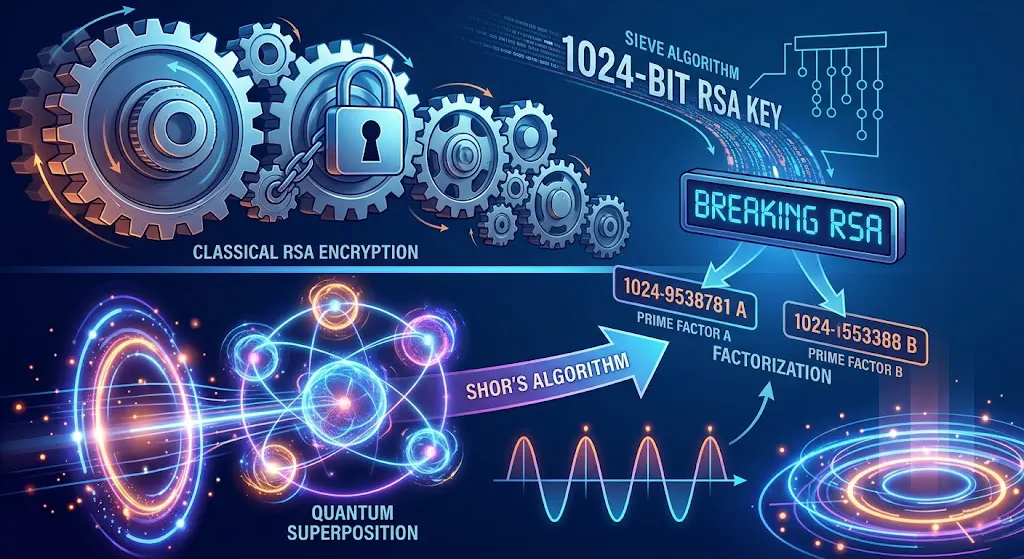
At the heart of our modern digital trust lies the RSA cryptosystem. For decades, it has relied on a simple mathematical truth: it is incredibly easy for a computer to multiply two large prime numbers together, but it is computationally infeasible for a classical machine to reverse the process—factoring that result back into its original primes. This “asymmetric” difficulty has been our shield.
Quantum computers break this shield by operating under different laws of physics. They utilize quantum superposition and entanglement to perform calculations that would take a standard supercomputer thousands of years in mere minutes. Specifically, Shor’s Algorithm provides a shortcut that bypasses the brute-force approach, solving the integer factorization problem with exponential efficiency.
The Critical Threshold: Understanding Logical Qubits
It is a common misconception that simply owning a “1,000-qubit processor” is enough to break encryption. In reality, physical qubits are notoriously “noisy” and highly susceptible to decoherence. The true threat emerges only when these physical units are error-corrected and scaled into stable logical qubits.
We are currently in a pivotal transition phase. While the hardware scale is growing, the focus has shifted toward quantum resilience, specifically the need for robust error correction. Until a system achieves high-fidelity logical qubits, the threat of a Quantum vs RSA Day Zero remains theoretical, but the pace of development is accelerating. However, as organizations continue to improve gate fidelity and error rates, the “Day Zero” window is narrowing, making it essential to understand the broader Cyber Security 101 principles that will govern our transition to post-quantum standards.
Predicting the Timeline: When Will Quantum vs RSA Day Zero Arrive?
The cybersecurity community is currently divided into two distinct camps regarding the arrival of Q-Day. The variance in these predictions is driven by how one interprets the speed of error-correction technology rather than just the number of physical qubits.
- The Conservative View (2030–2035): Many experts argue that the sheer physical hardware limitations—specifically the difficulty of maintaining stable, error-free operations at scale—will buy the world another decade. They point to the “noise” in current quantum processors as a significant hurdle that won’t be cleared overnight.
- The Radical View (2027–2028): A growing body of researchers highlights recent breakthroughs in “Logical Qubit” stability. If current trends in gate fidelity continue to accelerate, we may see a cryptographically relevant quantum computer emerge much sooner than anticipated.

However, the most dangerous aspect of this timeline is the “Harvest Now, Decrypt Later” (HNDL) reality. Threat actors do not need a quantum computer today to be dangerous; they are already capturing and storing high-value encrypted traffic. Once a CRQC becomes available, they will decrypt this historical data in bulk. For any organization handling sensitive state or financial secrets, “Day Zero” has effectively already arrived. If your data has a shelf-life of five years or more, it is already at risk.
The Global Race for Post-Quantum Cryptography Standards
Governments have recognized that the shift to Post-Quantum Cryptography (PQC) is not a voluntary upgrade but a national security mandate. The U.S. National Institute of Standards and Technology (NIST) finalized the standards for FIPS 203 (ML-KEM) and FIPS 204 (ML-DSA) to replace legacy public-key encryption.
The Implementation Gap: Security Policy vs. Digital Reality
While national security memorandums are forcing critical infrastructure to pivot, the commercial sector remains alarmingly slow. Roughly 90% of Small and Medium Enterprises (SMEs) lack a “crypto-agile” framework. Crypto-agility refers to the ability of a system to swap out outdated cryptographic algorithms for quantum-resistant ones without a total infrastructure overhaul.
This lag is compounded by the complexity of legacy systems that were never designed to be upgraded. For those looking to secure their own environments, we suggest auditing your current setup against our privacy checklists.
Assessing the Commercial Landscape for SMEs
Most businesses are still operating on the assumption that current encryption will suffice for the next decade. This is a dangerous gamble. Whether you are managing a small office or a complex server rack, assessing your cyber resilience strategy is the only way to ensure that your organization doesn’t become the “low-hanging fruit” for quantum-enabled data exfiltration. As we’ve seen with recent breaches like the Salesforce data exposure, reliance on legacy security configurations without proactive upgrades is a recipe for disaster in an era of rapidly evolving threats.
How You Can Prepare for the Quantum Threat: A Tactical Response
The transition to a quantum-resistant architecture can feel overwhelming, but it is fundamentally an exercise in risk management. You do not need to replace every device in your office overnight; instead, you must prioritize “Crypto-Agility.” This means ensuring your current software and hardware stacks can support modular cryptographic updates as new standards mature.
3 Tactical Steps for Immediate Quantum Readiness
- Upgrade Your Hardware Root of Trust: Start moving your sensitive signing operations to best post-quantum HSM (Hardware Security Modules). These devices provide a secure environment for cryptographic keys that can be updated to support PQC algorithms.
- Quantum-Resistant VPN Protocols: The HNDL threat targets data in transit most aggressively. If you are still relying on legacy protocols, it is time to switch to a best quantum-resistant VPN. These services have begun integrating post-quantum key exchange mechanisms to shield your traffic from future decryption.
- Modernize Your Password Management: While passwords themselves aren’t the primary target for Shor’s Algorithm, the vaults that hold them are. Evaluate your security posture by using the best post-quantum password managers that prioritize forward-secrecy and robust encryption standards.
Expert Tip: The “Inventory First” Audit Approach
Before purchasing new security gear, conduct an audit of your network to identify where RSA and Elliptic Curve algorithms are being used. You cannot secure what you haven’t mapped. Use our Digital Disappearance Emergency Checklist to guide your initial audit and ensure you aren’t leaving backdoors open in your legacy systems.
Why the Window for Quantum Migration is Closing
The leap into the quantum era represents the most significant transformation in the history of the internet. While the exact date of “Day Zero” remains a subject of intense debate, the reality of the threat is undeniable. The window of opportunity to migrate your infrastructure is closing, and in the world of cybersecurity, latency is effectively a vulnerability.
Whether you are an SME looking to improve your cyber resilience or an individual concerned about privacy, planning for a Quantum vs RSA Day Zero is no longer optional. Remember, in the quantum era, being late is the same as being leaked. Stay tuned to The Quantum Frontier as we continue to track every qubit breakthrough that threatens—and protects—your digital life.
Frequently Asked Questions (FAQ) About Q-Day and RSA
Can you prevent a Quantum vs RSA Day Zero?
By implementing PQC today, you can mitigate the impact of future quantum decryption.
Can a quantum computer crack my Bitcoin wallet?
The short answer is yes, if your wallet relies on ECDSA (Elliptic Curve Digital Signature Algorithm), which is the standard for Bitcoin addresses. Quantum computers are theoretically far more efficient at breaking Elliptic Curve cryptography than RSA. However, most modern wallets use “hashed” addresses (P2PKH), which provide a layer of protection. To stay ahead, explore our guides on best quantum-safe security keys to ensure your long-term assets are shielded.
Is AES-256 safe from quantum computers?
Yes, AES-256 is widely considered “quantum-resistant.” While Grover’s Algorithm can theoretically speed up brute-force attacks against symmetric encryption, it only provides a quadratic speedup. By using a 256-bit key, the effective security remains at a robust 128 bits, which is still computationally impossible to crack for the foreseeable future.
What is “Moseca’s Law” of quantum computing?
Named after Michele Mosca, a pioneer in quantum cryptography, this “law” serves as a reality check for the industry. It suggests that if the risk of your data being compromised is high, and the time it takes to transition to quantum-safe standards is longer than the time until a quantum computer is built, you are already in a “danger zone.” It’s the quantum equivalent of Moore’s Law—a constant reminder that the clock is running faster than our infrastructure updates.
Do I need to change all my passwords for Q-Day?
Not exactly. Q-Day is fundamentally about breaking the algorithms used to encrypt data in transit and at rest, not about brute-forcing passwords. While using a strong, AI-driven password rotation tool is a best practice for general security, you should focus your primary effort on upgrading your software and communication protocols to use PQC-ready math (like ML-KEM).
Continue Reading
The 2026 PQC Mandate: 3 Critical Steps to Master NIST PQC Standards for Enterprise Security
As of 2026, the transition to NIST PQC Standards is no longer a choice but a regulatory mandate....
Read Insight →