 By
By 
The cybersecurity landscape has undergone a seismic shift as we cross the “Intelligence Frontier.” We have moved beyond the era where hackers manually labored over every line of exploit code.
Today, the reality of 2026 is dominated by an industrial-scale production of threats. Generative AI Malware—malicious software created or optimized by Large Language Models (LLMs)—has become the preferred weapon for automated threat actors.
These entities no longer rely on static files; instead, they deploy polymorphic code that evolves after every infection to slip past traditional defenses. For the team at OnlineShieldHub, identifying the subtle “fingerprints” left by AI in source code is no longer a luxury—it is a mandatory survival skill in a world where machines are increasingly writing the rules of engagement.
How Machines Write Malware: The Attack Patterns of Generative AI Malware
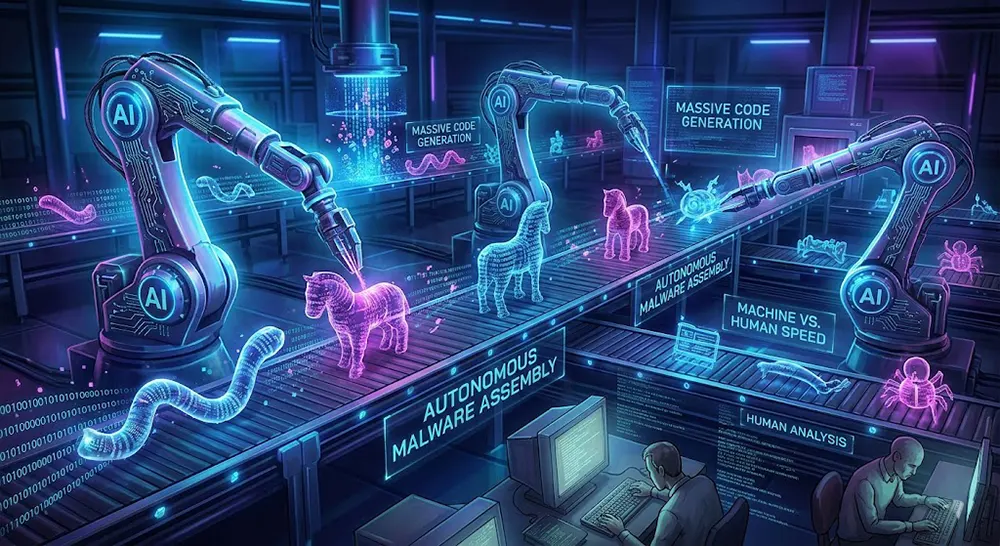
To defeat the bot, you must understand its workflow. Generative AI Malware isn’t just about speed; it’s about the relentless industrialization of the entire attack lifecycle.
1. Rapid Prototyping and Iterative Payloads
In 2026, AI can generate thousands of unique code variants in seconds. While a human coder might take days to bypass a specific firewall or EDR (Endpoint Detection and Response) system, an LLM-driven agent iterates through permutations until it finds the exact logic gate that stays silent. This “brute-force intelligence” makes Generative AI Malware a moving target that traditional signature-based tools simply cannot track.
2. Context-Aware Phishing and Dynamic Delivery
Modern AI doesn’t just send generic spam. It utilizes “Agentic AI” to analyze public data and social media, creating highly personalized phishing campaigns. The attached Generative AI Malware is often customized on the fly to match the victim’s specific OS version and installed software. You can read more about how these autonomous agents operate in our analysis of agentic AI security mal-action.
3. Automated Zero-Day Exploit Discovery
LLMs are now proficient at scanning massive open-source repositories for logic flaws. Once a vulnerability is identified, the AI automatically drafts a functional exploit. This drastically narrows the “Mean Time to Weaponization,” leaving security teams with almost zero time to patch systems before Generative AI Malware begins to circulate.
Expert Tip: Monitor your network for “High-Frequency Probing.” If you notice a sudden influx of unique, low-level connection attempts that change behavior every few seconds, you are likely being audited by an automated AI discovery tool.
Detection Techniques: Spotting the “Machine Fingerprint” in Generative AI Malware
Detecting code written by a machine is akin to spotting a high-quality forgery; at first glance, it looks perfect, but under a “microscope,” the mathematical signatures of a Large Language Model become apparent. To identify Generative AI Malware, security analysts must look beyond the surface level of the code.
1. Identifying Semantic Inconsistencies
LLMs are masters of syntax but often lack a holistic understanding of complex system architecture. Generative AI Malware frequently exhibits “perfect” local logic but contains strange architectural decisions. You might see a script that uses high-level, advanced libraries for simple tasks or includes redundant functions that a human developer would have optimized away. These “uncanny valley” moments in code structure are a primary indicator of machine generation.
2. Forensic Coding Style Analysis
Every LLM has a “dialect”—a specific way it prefers to name variables, structure loops, and even write comments. For example, AI-generated code often uses overly descriptive variable names (e.g., encrypted_payload_buffer_hex) and includes comments that explain what the code does rather than why. By cross-referencing these patterns against known outputs from models like GPT-4 or Claude 3, analysts can perform high-accuracy AI-generated code detection.
3. Entropy and Obfuscation Uniformity
Human attackers often hide their code using creative, “messy” obfuscation techniques that reflect their personal habits. In contrast, Generative AI Malware tends to use mathematically uniform obfuscation. When we analyze the entropy (randomness) of a file, machine-obfuscated sections often show a lack of the “logical noise” typically found in human-written scripts.
4. Deploying AI vs. AI Defenses
The most effective way to catch an AI is with another AI. Modern security suites now integrate specialized machine learning models trained specifically to recognize the statistical distribution of LLM-generated tokens. These tools provide a “probability score” of machine origin, allowing teams to prioritize the analysis of scripts that show high likelihoods of being automated threats.
Expert Tip: Use automated code stylometry tools. These can detect if a malicious script’s “DNA” matches the training weights of popular LLMs, providing a definitive lead during incident response.
The Rise of Polymorphic Generative AI Malware
The transition from static code to Polymorphic Generative AI Malware represents the most significant threat escalation in 2026. This is not just malware that hides; it is malware that evolves in real-time.
The Self-Mutating Code Engine
Unlike traditional polymorphic malware that uses simple encryption engines to change its signature, Generative AI Malware uses an integrated “mini-LLM” or an API bridge to rewrite its own source code. After every successful infection, the malware generates a new version of itself. This changes the file’s hash and structure, making it invisible to legacy signature-based antivirus systems. This shift aligns with the latest research on AI-driven code mutations presented at recent global security briefings.
Real-Time Environmental Adaptation
In 2026, we are seeing “Live” threats. When a piece of Generative AI Malware enters a new environment, it performs a local reconnaissance and can query a remote AI server for a custom-tailored payload. This allows it to bypass specific defenses like an AI firewall setup or target best quantum-threat antivirus configurations. Because the code logic changes at an abstract level, identifying these threats now requires quantum malware detectors capable of deep behavioral analysis.
Defensive Strategy: Staying Ahead of the Bot
In an era where Generative AI Malware can outpace human reaction time, your defensive posture must transition from reactive to proactive. Relying on “waiting for a breach” is a losing strategy.
1. Behavioral Analysis Over File Scanning
Since the signatures of Generative AI Malware are constantly shifting, security teams must focus on what a file does rather than what it is. Modern AI-powered VPN reviews and EDR platforms now prioritize behavioral heuristics. If a script attempts to escalate privileges or connect to an unauthorized LLM gateway, it is neutralized instantly. This methodology is a core component of the NIST AI Risk Management Framework, which emphasizes continuous monitoring of AI-generated assets.
2. Implementing “Zero Trust for Code”
The concept of Zero Trust must extend to the code itself. Every script, even those from internal developers, must be treated as untrusted. Before deployment, use private LLM setups to sandbox and audit the logic. This “Never Trust, Always Verify” approach is inspired by the CISA Zero Trust Maturity Model, ensuring that even machine-generated code follows strict security protocols.
3. Hardening LLM Gateways
Organizations must secure their interactions with AI models to prevent “Prompt Injection” attacks that could force an LLM to generate malicious payloads. By following the OWASP Top 10 for LLMs, you can implement filters that detect when a user—or a piece of hidden Generative AI Malware—is trying to abuse the model to leak sensitive data.

The Cat and Mouse Game 2.0
The rise of Generative AI Malware marks a turning point in digital history. We have entered the “Cat and Mouse Game 2.0,” where the speed of attack is limited only by the attacker’s compute power. While this shift is daunting, it does not mean the end of cybersecurity; rather, it marks the evolution of the field.
As we have explored, the “machine fingerprint” is detectable if you have the right tools and the right mindset. In 2026, the most resilient organizations will be those that embrace cyber resilience strategies over simple defense spending. AI malware might be faster, but human intuition—augmented by our own AI defenders—remains the ultimate chốt chặn (last line of defense).
Call to Action: Don’t let your security go obsolete. Follow the AI Security Trends section on OnlineShieldHub to stay updated on the latest detection tools and defense frameworks designed for the 2026 threat landscape.
FAQ: Mastering Generative AI Malware Defense
Can AI write malware entirely on its own without human help?
While “Human-in-the-loop” is still common for high-value targets, we are seeing a surge in “Agentic AI” that can independently scan, exploit, and pivot through a network. The role of the human is shifting from “writer” to “campaign manager.”
How can I tell if a script was written by ChatGPT or Claude?
Look for “Semantic Perfection.” AI-generated code often lacks the idiosyncratic “hacks” or messy variable names typical of a tired human developer. Using specialized quantum malware detectors can help identify the underlying token patterns of specific LLMs.
Do traditional antivirus programs still work?
Legacy antivirus (signature-based) is largely ineffective against polymorphic Generative AI Malware. You should upgrade to best AI-driven antivirus for macOS or Windows, which uses real-time behavioral monitoring to stop unknown threats.
Why is AI malware more dangerous than the “WannaCry” style worms?
Traditional worms are “one-size-fits-all.” Generative AI Malware is “bespoke.” It can analyze your network’s unique architecture and rewrite its payload to exploit your specific configuration, making it much harder to create a universal patch.
Continue Reading
From GenAI to Agentic AI: Why “Mal-action” is the New Top Threat of 2026
In 2026, the primary cybersecurity risk has evolved from AI saying the wrong thing (hallucinations) to AI doing...
Read Insight →