 By
By 
In the landscape of 2026, the question is no longer “if” your perimeter will be breached, but “when.” We live in an era where AI-automated polymorphic malware can find the microscopic cracks in even the most robust firewalls. The “bulletproof” myth—the dangerous belief that if you buy enough software layers, you are invincible—is dead. This mindset is a fiscal trap, leading many to purchase the 11th antivirus solution while neglecting the fundamental truth: security is about survival.
To survive, we must shift our philosophy. It is time to pivot from “Defense” (the futile attempt to keep them out) to a “Cyber Resilience Strategy” (the practical mastery of how fast you get back up). If you are spending your entire 2026 security budget on ten different locks but neglecting to buy a spare key, you are not secure—you are merely waiting for a disaster.
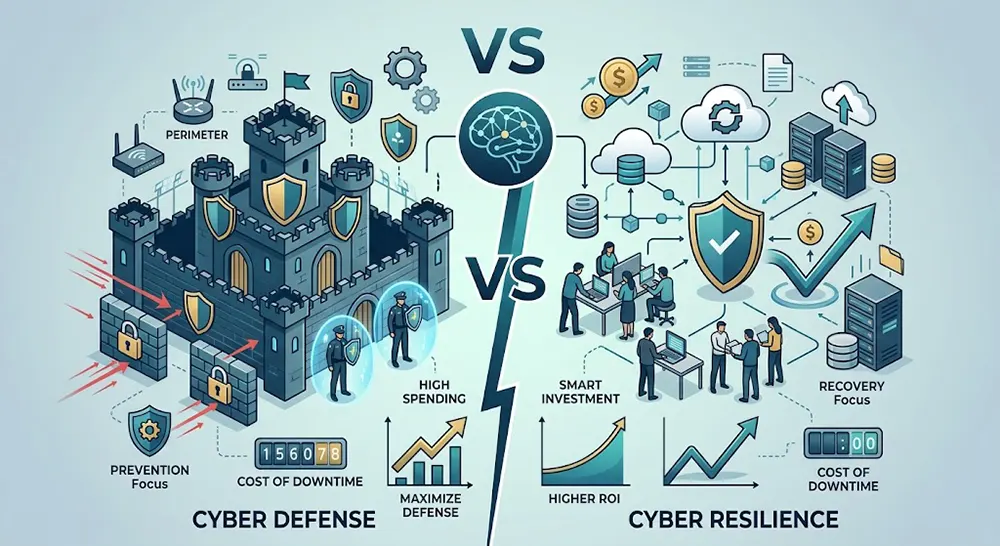
Defense vs. Resilience: A Financial Comparison
Security budgets are finite. When you pour the vast majority of your capital into preventative tools, you quickly hit the wall of diminishing returns. Adding that fifth layer of encryption might provide a negligible 1% increase in security while costing a fortune in subscription fees, system overhead, and technical complexity.
The ROI of Recovery
The true Cyber Resilience Strategy understands the stark difference between “cost” and “value.” Consider the impact of a ransomware attack:
- The Preventative Approach: Costs thousands in high-end endpoint security but offers zero protection if a sophisticated zero-day exploit bypasses your perimeter.
- The Resilience Approach: Invests in immutable backups and redundant hardware. Even if your system is fully encrypted by an attacker, you are back online in hours, not weeks.
In the “Zero-Trust” reality of 2026, assuming you are already compromised is the most cost-effective mindset you can adopt. It forces you to invest in infrastructure that guarantees business continuity, effectively transforming your security budget from a “sunken cost” into a strategic survival insurance policy.
Expert Tip: The Diminishing Return Threshold
Stop chasing the “100% secure” ghost. If a security product costs more than 15% of your total IT budget but only mitigates a low-probability risk, pivot that capital toward Disaster Recovery Gear. Your goal is to maximize the speed of recovery, not just the thickness of the walls.
The Architecture of Recovery: What to Buy First
If you are revamping your 2026 Security Budget, you must stop thinking like a fortress builder and start thinking like a system architect. Your priority is to build an environment that can withstand a “scorched earth” scenario. Here is where your capital should go first.
1. Immutable Backups: The Gold Standard

This is your most critical investment. An immutable backup is data that cannot be altered, encrypted, or deleted by ransomware once it is written. Even if an attacker gains administrative access to your network, your backups remain locked and pristine.
- Action: Invest in WORM (Write Once, Read Many) cloud storage or a dedicated NAS (Network Attached Storage) that supports object locking at the hardware level.
2. Automated Incident Response (IR) Tools
Time is your greatest enemy during an active breach. You need software capable of “self-healing” or, at the very least, automated isolation. Invest in tools that detect anomalous behavior and automatically quarantine infected segments before the malware spreads laterally. By severing the infected “limb,” you preserve the rest of the digital organism.
3. Redundant Hardware for the Home Lab
Whether it is a “Hot site” for your small business or a mirror-server for your private cloud, redundancy is non-negotiable. If your primary machine is compromised, having a pre-configured, offline backup of your system state ensures you aren’t starting from scratch.
Understanding the Metrics: RTO vs. RPO
To build a Cyber Resilience Strategy that actually works, you must master two fundamental metrics: RTO (Recovery Time Objective) and RPO (Recovery Point Objective). Most people buy security gear based on “feelings”; you will buy yours based on these hard numbers.
Defining Your Limits
- RPO (Recovery Point Objective): This measures how much data loss you can tolerate. If your RPO is “one hour,” you must perform backups at least every hour to ensure you never lose more than 60 minutes of progress.
- RTO (Recovery Time Objective): This measures the maximum acceptable downtime. If your RTO is “30 minutes,” you need high-speed, local restore capabilities. If it takes you four hours to pull data from a slow cloud archive, you have failed your RTO.
Strategic Advice: Aligning Purchases to Metrics
Do not overspend on hardware that doesn’t fit your needs. If your business operations require an RTO of under one hour, do not waste your budget on slow, tape-based or cloud-only restores. Invest that capital into high-speed local flash-storage backups or “hot” standby servers that can take over instantly. Your security budget must be precision-engineered to meet the specific “cost of downtime” for your unique digital life.
Expert Tip: The RTO/RPO Audit
Ask yourself: “If I lose my workstation right now, how much work is gone (RPO) and when can I realistically be back to typing (RTO)?” If the answer is “I don’t know,” your current security spending is likely misaligned. Audit your storage speeds and backup frequencies this weekend.
How to Allocate Your 2026 Security Budget
Most security budgets are mismanaged because they are reactive, driven by fear of the latest headline rather than a calculated assessment of operational survival. To shift your 2026 Security Budget into a truly resilient model, you should adopt the 60/40 Rule.
The 60/40 Rule of Strategic Investing
- 60% for Prevention: This covers your standard perimeter defense—VPNs, advanced firewalls, and AI-driven endpoint protection. This keeps the “low-hanging fruit” attackers out.
- 40% for Recovery: This is your “Resilience Fund.” It is earmarked exclusively for immutable backup storage, Incident Response (IR) software, and redundant hardware to ensure continuity.
Evaluating Vendors and the “Kill Switch” Investment
When evaluating vendors, look beyond the marketing jargon. Demand Data Integrity Guarantees. If a cloud backup provider cannot demonstrate that their data is immutable and resistant to administrative deletion, they are a liability, not an asset.
Furthermore, prioritize the “Kill Switch” Investment. In 2026, you should invest in centralized identity and access management (IAM) solutions that allow you to sever all network connections or disable specific user privileges globally with a single click. When a breach happens, the ability to “go dark” instantly is the difference between a minor incident and a total data catastrophe.
Testing Your Resilience: The “Fire Drill” for Data
Buying the right hardware is only half the battle. A Cyber Resilience Strategy is only as good as its last successful test. If you have not “broken” your system on purpose, you do not actually know if you are protected.
Shift to Pentesting Over Bloatware
Stop purchasing the “11th layer” of security software. Instead, use that budget to hire professional Pentest (penetration testing) services or use sophisticated automated vulnerability scanners. Knowing your actual attack surface is infinitely more valuable than adding another piece of software that creates “alert fatigue” without stopping a real threat.
The Power of Business Continuity Drills
Perform “fire drills” for your home lab or business infrastructure once per quarter. This is a practical, hands-on exercise:
- Simulate an Infection: Take a non-production node and simulate a ransomware-style file lockdown.
- Execute the Recovery: Attempt to restore the system state using your immutable backups.
- Time the RTO: Record exactly how long it takes to return to a fully functional state.
Expert Tip: The “Oops” Audit
Periodically delete a critical—but non-essential—file and time your restoration process. If you find the backup is corrupted or the retrieval process is more complex than your documentation suggests, you have just saved yourself from a future disaster. Treat your recovery process as a “living” document, not a set-and-forget configuration.
Beyond the Perimeter – Buying Peace of Mind through Resilience
In the volatile digital environment of 2026, the distinction between a victim and a survivor is defined by their Cyber Resilience Strategy. Defense is essentially a gamble—you are betting that your walls are higher than the attacker’s tools. Resilience, however, is a guarantee. It is the tactical acknowledgement that systems fail, humans err, and threats evolve.
By reallocating your 2026 Security Budget toward recovery-centric assets, you are not just purchasing software; you are buying the ability to absorb a blow and continue your operations without missing a beat. The ultimate goal of this investment is peace of mind. When you know exactly how fast you can restore your life or your business from an immutable source, you stop fearing the inevitable breach and start focusing on your growth.
Final Actionable Tip: Do not wait for the next “Security Awareness Month” or a system alert to act. Today, perform a “Data Integrity Check.” Attempt to restore a single, vital file from your secondary backup. If you cannot do it successfully within five minutes, stop buying new security features and fix your backup architecture. That is the only way to prove you are truly resilient.
FAQ: Strategic Investing in Cyber Resilience
Q: Is Cyber Resilience more expensive than Cyber Defense? A: It may seem like a higher upfront investment, but it is vastly cheaper than the alternative. The cost of a total system failure—including potential ransom payments, legal fees, and weeks of lost operational time—dwarfs the cost of building a redundant, resilient infrastructure. You are essentially paying for long-term cost avoidance.
Q: What is the best immutable backup tool for home users? A: For a robust home lab, a Synology NAS configured with “Snapshot Replication” is an industry favorite. If you prefer cloud-based solutions, services like Backblaze B2, when configured with Object Lock enabled, provide high-grade, immutable storage that is accessible yet protected from ransomware.
Q: Why is RTO more important than RPO for small businesses? A: While RPO defines how much data you lose, RTO defines how much business you lose. If your site or database is offline for days, you lose customer trust and revenue, which are often more difficult to recover than a few hours of lost data. Prioritizing a low RTO ensures you remain a viable entity even after an attack.
Q: Can AI help with Incident Response Planning? A: Absolutely. AI-driven Incident Response (IR) tools can monitor traffic patterns in real-time and automatically isolate infected nodes the millisecond an anomaly is detected. By automating the “triage” phase, AI allows you to drastically improve your RTO, ensuring that the human team only steps in for the final recovery phase.
Continue Reading
The Privacy-First Smartphone Guide 2026: Reclaiming Your Identity in the Age of AI Agents
In 2026, standard flagship phones are no longer tools—they are data-collection terminals. To regain control, you must prioritize...
Read Insight →