 By
By 
The digital landscape has officially shifted. For years, “Q-Day”—the moment quantum computers break modern encryption—was a theoretical ghost story whispered in research labs. However, in 2026, that ghost has taken the form of federal law. National security memorandums and global regulatory bodies have now solidified the NIST PQC Standards as the mandatory baseline for enterprise data protection.
The era of “Wait and See” is dead. Legacy algorithms like RSA and ECC are officially on borrowed time, vulnerable to “Harvest Now, Decrypt Later” (HNDL) attacks that put decades of encrypted data at risk. At OnlineShieldHub, we recognize that for the modern CISO, this isn’t just a technical upgrade—nurturing Quantum Compliance is now a prerequisite for digital sovereignty. Whether you are managing global financial transactions or securing local IoT grids, understanding the transition from Quantum Computing vs. RSA to lattice-based math is the defining challenge of the year.
Deep Dive: The New Cryptographic Holy Trinity (FIPS 203-205)
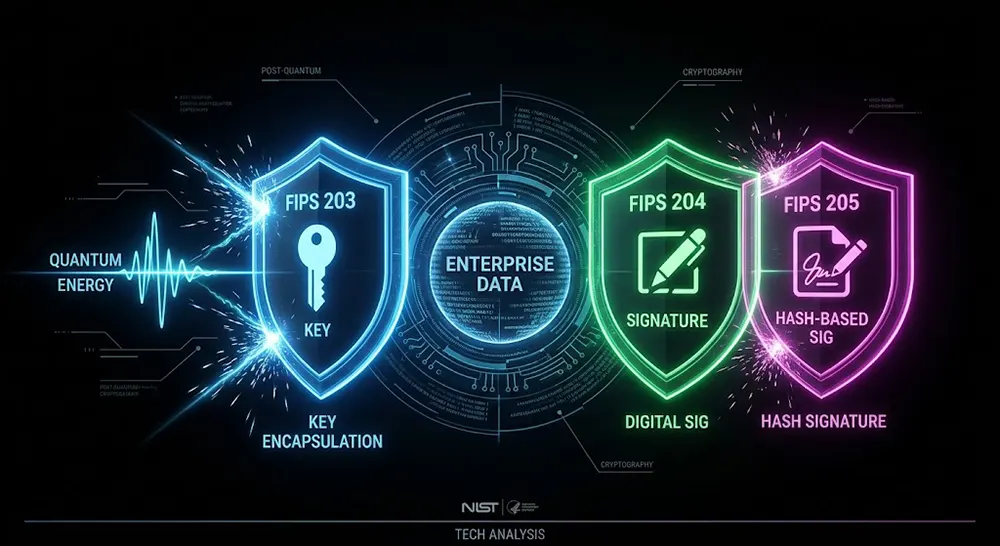
To achieve full Quantum Compliance, enterprises must integrate the three pillars of the NIST PQC Standards. These aren’t just incremental updates; they represent a fundamental shift toward lattice-based and hash-based cryptography.
FIPS 203 (ML-KEM): The Shield for Key Exchange
Formerly known as Kyber, ML-KEM (Module-Lattice-Based Key-Encapsulation Mechanism) is now the primary standard for securing key exchanges. In the post-quantum world, ML-KEM ensures that even if a quantum attacker intercepts the handshake between two servers, they cannot derive the shared secret.
For those currently utilizing NordVPN’s quantum security features, you are already seeing early implementations of these mechanisms in action. ML-KEM is favored for its relatively small key sizes and high speed, making it the most versatile tool in your 2026 arsenal.
FIPS 204 (ML-DSA): Securing Digital Signatures
The integrity of your software updates, financial contracts, and identity logs now rests on ML-DSA (formerly Dilithium). This Module-Lattice-Based Digital Signature Algorithm is designed to replace ECDSA. It provides the heavy-duty verification needed to ensure that code hasn’t been tampered with by an adversary wielding quantum-level processing power.
FIPS 205 (SLH-DSA): The Stateless Backup
While lattice-based math is robust, NIST introduced SLH-DSA (Stateless Hash-Based Digital Signature Algorithm, formerly Sphincs+) as a “safety net.” Because it relies on different mathematical properties than ML-KEM or ML-DSA, it remains secure even if future breakthroughs find a vulnerability in lattice-based logic. It is slower and produces larger signatures, but for high-stakes enterprise security, having a “Plan B” included in the NIST PQC Standards is essential.
Expert Tip: When auditing your Post-Quantum HSMs, ensure your hardware supports both ML-KEM and ML-DSA natively. Software-only emulation can lead to 300% performance degradation on high-traffic gateways.
Technical Comparison: NIST PQC Standards Algorithms
| Standard | Former Name | Primary Use Case | Performance | Key Size |
| FIPS 203 | ML-KEM (Kyber) | Key Exchange / Encryption | Ultra-Fast | Small |
| FIPS 204 | ML-DSA (Dilithium) | Digital Signatures | Fast | Medium |
| FIPS 205 | SLH-DSA (Sphincs+) | Backup Signatures | Slow | Large |
The Migration Strategy: From Legacy to Lattice
Transitioning to NIST PQC Standards isn’t a “flip the switch” operation; it’s a surgical migration of your entire cryptographic fabric. In 2026, the gold standard for enterprise risk management is Cryptographic Agility.
Hybrid Implementation: The “Dual-Signature” Safety Net
NIST and the NSA currently recommend a hybrid approach. This involves wrapping your current RSA or ECC encryption layers with a second layer of NIST PQC Standards (specifically ML-KEM).
The logic is simple: if the new lattice-based math is found to have a flaw, the legacy encryption still holds. If a quantum computer attacks, the PQC layer provides the defense. For a practical look at how this is being deployed in consumer tech, check out the latest quantum-safe VPN deals for 2026, which utilize these hybrid tunnels to protect traffic today.
Conducting the Crypto-Inventory
You cannot protect what you cannot see. Enterprises must identify every instance of RSA-2048 and ECDSA within their stack. This includes:
- Web Servers: TLS certificates and load balancers.
- Internal Tools: SSH keys and automated API tokens.
- Data at Rest: Encrypted databases and archived backups.
Expert Tip: Use automated discovery tools to map your “Quantum Exposure.” Pay special attention to Shadow IoT security risks, as unmanaged devices often use hardcoded, non-upgradable legacy encryption.
Managing Bandwidth and Performance Overheads
The NIST PQC Standards come with a “size tax.” ML-KEM and ML-DSA keys and signatures are significantly larger than their ECC counterparts.
- Latency: Expect a slight increase in TLS handshake times.
- Packet Fragmentation: Larger signatures can cause issues with older network protocols and MTU settings.
- Power Consumption: For mobile and IoT, the computational load of lattice-based math may require optimized AI-powered VPN route optimizers to maintain battery life.

Quantum Compliance: Regulatory & Industry Impacts
The 2026 mandate isn’t just about security; it’s about the “license to operate.” Various sectors are now facing strict timelines to prove their Quantum Compliance.
Financial Services and Global Banking
The financial sector is the primary target for “Harvest Now, Decrypt Later” attacks. Swift and other global interbank systems have begun integrating zero-knowledge proofs alongside NIST PQC Standards to ensure that transaction metadata remains private even decades from now. If your organization handles cross-border payments, your 2026 audit will require documented PQC readiness.
Critical Infrastructure and the HNDL Threat
Energy grids and telecommunications providers are shifting to “Quantum-Hardened” hardware. The threat isn’t just a future breach; it’s the data being stolen today for decryption tomorrow. For those building local resilient networks, we recommend reviewing our decentralized VPN mesh builder tools to ensure peer-to-peer communications are quantum-resistant.
Securing the Third-Party Supply Chain
Your Quantum Compliance is only as strong as your weakest vendor. In 2026, Procurement Officers are adding “PQC Attestation” to vendor contracts. You must ensure that your software providers are migrating their code-signing certificates to ML-DSA (FIPS 204).
Case Study (Hypothetical): In early 2026, a major SaaS provider suffered a “Quantum-Ready” impersonation attack because they failed to update their internal API signatures. The resulting breach cost $4.2M in regulatory fines—a price far higher than the cost of early migration.
Critical Challenges in the 2026 NIST PQC Standards Transition
While the roadmap is clear, the execution of NIST PQC Standards across a global enterprise is fraught with technical and human hurdles. Addressing these early is the difference between a secure migration and a catastrophic system failure.
Hardware Limitations and Legacy Debt
The most significant barrier to Quantum Compliance is “frozen” hardware. Many older Hardware Security Modules (HSMs) and Industrial IoT devices lack the memory and processing power to handle the larger key sizes of ML-KEM or the complex lattice math of ML-DSA.
- The Replacement Cycle: Organizations must decide between expensive firmware overhauls or total hardware replacement.
- Edge Computing: Small-scale sensors are particularly vulnerable. For those managing smart homes or industrial plants, reviewing the best VPN for IoT smart home security in 2026 is a vital first step in wrapping legacy devices in a quantum-safe perimeter.
The Cryptographic Talent Shortage
There is a massive gap between the need for quantum-safe security and the number of engineers who understand lattice-based cryptography. This “Talent Gap” means many firms will rely on automated tools. We recommend utilizing AI-powered password rotation tools to manage the complexity of updating thousands of credentials to the new standards without manual error.
Algorithm Fragility and Side-Channel Attacks
Even though NIST PQC Standards are mathematically sound, their implementation can be fragile. Researchers are already investigating side-channel attacks—where an attacker measures power consumption or electromagnetic leaks to steal keys. Staying updated via quantum malware detectors is essential to catch these sophisticated, hardware-level exploits.
Achieving Sovereignty Through Cryptographic Agility
The verdict for 2026 is definitive: NIST PQC Standards are the new baseline for digital trust. The transition is not a one-time patch but a fundamental evolution in how we define “secure.”
Organizations that move early—implementing hybrid models and conducting deep crypto-inventories—will find themselves with a competitive advantage. Those that wait risk more than just data breaches; they risk losing the ability to participate in the global, regulated economy.
The marathon has started, and the starting gun was the 2026 mandate. To ensure your personal and professional data remains locked away from quantum eyes, consider starting with the basics: secure your primary access points using the best post-quantum password managers of 2026.
FAQ: Master the NIST PQC Standards & Quantum Compliance
What are FIPS 203, 204, and 205?
These are the official designations for the three primary NIST PQC Standards. FIPS 203 (ML-KEM) handles key encapsulation, FIPS 204 (ML-DSA) is for digital signatures, and FIPS 205 (SLH-DSA) is a hash-based backup signature method. Together, they form the core of The Quantum Frontier security stack.
Does the PQC Mandate apply to small businesses?
While the 2026 mandate specifically targets federal agencies and critical infrastructure, there is a massive “trickle-down” effect. Small businesses will achieve compliance primarily through automated software updates and by using the best quantum-resistant VPNs for their remote workforces. For those looking to proactively audit their systems, following an official Quantum Readiness Guide is the best way to ensure your third-party vendors and cloud providers are meeting the new NIST requirements.
How do I test ML-KEM in my current environment?
Developers can use open-source libraries like liboqs (Open Quantum Safe) to test these algorithms in sandbox environments. For enterprise-grade testing, look for vendors offering “Quantum-Safe Sandboxes” or best post-quantum HSM solutions that support dual-signature testing modes.
Will NIST PQC Standards break existing internet protocols?
Protocols like TLS 1.3 and SSH are being updated to support these standards. However, the larger key sizes may cause issues with older firewalls. We suggest monitoring your network with AI firewall setups to detect and mitigate packet fragmentation caused by larger PQC handshakes.
Continue Reading
Quantum Computing vs RSA Day Zero: When Will Encryption Collapse?
As of April 2026, the race to "Q-Day"—the point where quantum computers can break modern RSA-2048 encryption—is accelerating....
Read Insight →