 By
By 
The human mind is the final frontier of absolute privacy. As commercial consumer adoption escalates, the convergence of artificial intelligence and invasive brain-computer interfaces introduces unprecedented structural vulnerabilities. Protecting the raw bio-electric signals generated by your central nervous system requires moving beyond conventional cybersecurity frameworks.
Deploying commercial hardware like Neuralink and Neurotech Devices means your most intimate thoughts, subconscious reactions, and cognitive states are translated into digital data streams. If left unprotected, this neural telemetry presents catastrophic exploitation risks. This technical guide establishes the foundational threat model for neural interfaces and delivers actionable architectural blueprints to secure your cognitive liberty.
The Dawn of Neuro-Capitalism: Why Neuralink and Neurotech Devices Pose Unprecedented Privacy Threats
Commercializing the human nervous system has catalyzed a highly aggressive ecosystem known as neuro-capitalism. Traditional biometric vectors—such as fingerprints or iris scans—are static identifiers used primarily for authentication. Conversely, the telemetry harvested by Neuralink and Neurotech Devices is dynamic, continuous, and inherently tied to your subconscious cognitive processing.
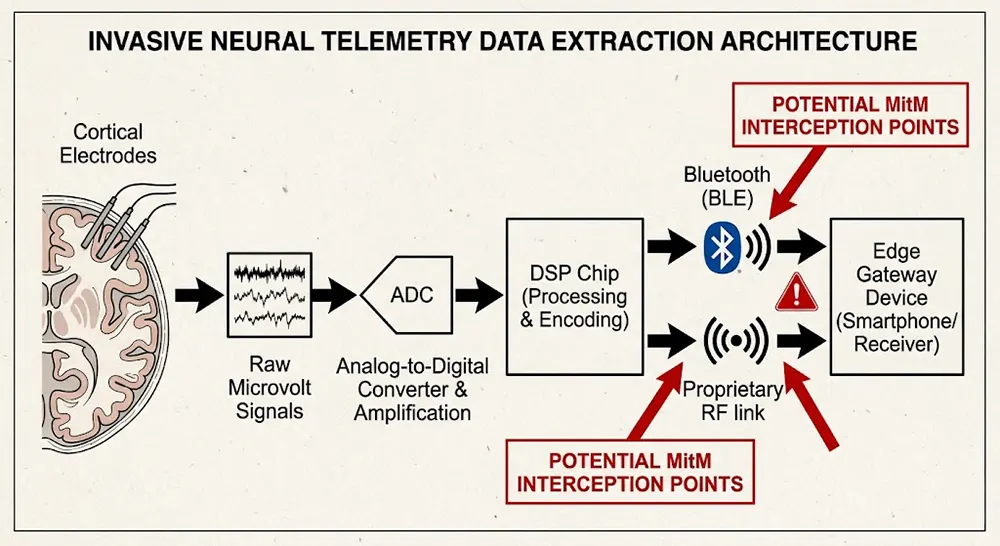
[Cortical Electrodes] ──> [Raw Microvolt Signals] ──> [On-Chip DSP] ──> [Bluetooth/RF Uplink] ──> [Edge Gateway/App]
When you interface with a consumer-grade brain-computer interface (BCI), micro-electrode arrays record the electrical firing of your neurons in real time. These microvolt spikes are processed by an integrated digital signal processor (DSP) and transmitted to external edge devices. Tech conglomerates do not just seek to map intent; they aim to monetize the underlying emotional vectors, focus tracking, and algorithmic responses triggered by real-world stimuli.
The underlying monetization engine relies heavily on algorithmic signal decoding. By aggregating vast datasets of human neural activity, corporate entities train deep learning models to predict user preferences before they are consciously formulated. Keeping track of emerging AI security trends reveals that these predictive neural analytics will soon form the bedrock of non-consensual cognitive profiling.
Decoding the Vulnerability: How Bad Actors Intercept Raw Electroencephalogram (EEG) Telemetry
The structural vulnerabilities of modern neurotech do not lie within the biological tissue, but within the digital transport layer. Raw electroencephalogram (EEG) telemetry and local field potentials (LFPs) travel over standard wireless protocols like low-energy Bluetooth (BLE) or proprietary radio frequencies. Because these communication channels are frequently misconfigured, they invite sophisticated man-in-the-middle (MitM) interception exploits.
The Cryptographic Reality: Most wearable consumer neurotech devices optimize for battery longevity and thermal dissipation over heavy cryptographic computing. This architectural compromise results in weak, static symmetric key encryption that can be cracked by close-proximity hardware sniffers.
Once an adversary gains access to the raw data stream, they bypass the system’s feature extraction layers. Instead of reading processed commands like “move a mouse cursor,” a malicious actor captures the foundational neurological responses. This includes the P300 wave—a specific neuro-electric spike that occurs precisely 300 milliseconds after a brain recognizes a familiar stimulus.
Voltage (µV)
  ▲
  │       📊 Typical P300 Waveform Interception Profile
  │             [Peak Recognition Spike]
  │                 /───
  │                /
  │  ─────────────/       ─────────────► Time (ms)
  │  0           100     300     500
By injecting targeted visual or auditory stimuli into a user’s environment while monitoring for the P300 wave, an attacker can forcefully extract highly sensitive information. This attack methodology allows bad actors to map your recognition of bank logos, geographic locations, or cryptographic passwords without your explicit consent.
As automated exploitation frameworks evolve, this vector intersects dangerously with autonomous malicious software. Sophisticated threat actors are already engineering advanced systems to manipulate edge devices; understanding how these autonomous agents hijack client applications highlights why securing the neurological endpoint is so critical. For a deeper analysis of how these automated exploits function, see our breakdown of agentic-ai-security-mal-action-2026.
Structural Blueprint: 5 Non-Negotiable Privacy Tips for Neuralink and Neurotech Devices Users
Mitigating the privacy threat of direct neural interfaces requires shifting from reactive security to proactive, zero-trust infrastructure. Standard consumer settings are fundamentally inadequate for protecting brainwave telemetry. Implementing the following architectural countermeasures will dramatically harden your deployment of Neuralink and Neurotech Devices against structural data exploitation.

Tip 1: Implement Local Air-Gapped Telemetry Storage
The primary point of failure for consumer brain-computer interfaces is the automatic syncing of raw data to corporate clouds. To prevent this, you must construct a local, physical boundary for your data. Route all incoming signal logs away from commercial applications and store them exclusively on an isolated, non-networked storage cluster.
By keeping your data local, you ensure your raw cortical voltages remain within an unbreachable perimeter. If you want to replicate this level of self-contained infrastructure for your broader personal data ecosystem, you can follow our comprehensive tutorial on decentralized-cloud-setup-guide-2026 to establish a private, self-hosted data vault.
Tip 2: Enforce Local Homomorphic Encryption Wrappers
When your neural data must interact with external applications, standard encryption protocols fall short. Traditional encryption requires the system to decrypt the data before analyzing it, exposing your raw thoughts in plain text. Instead, you must wrap all telemetry packets generated by Neuralink and Neurotech Devices in homomorphic encryption layers before they leave your client device.
[Raw Brainwave Data] ──> [Homomorphic Wrapper] ──> [Encrypted Processing] ──> [Secure Output]
                                                         ▲
                                               (No Decryption Needed)
This mathematical framework allows third-party analytical programs to process your neural commands without ever viewing or compromising the underlying biological signatures. Embracing this architectural standard aligns perfectly with the broader cryptographic movement toward data invisibility. To understand the mechanics of processing obfuscated information securely, review our technical guide on zero-knowledge-proofs-privacy-preserving-tech.
Tip 3: Opt-Out of Continuous Machine Learning Model Telemetry Sharing
By default, modern neurotech ecosystems treat your brainwaves as training data for their proprietary machine learning models. These continuous feedback loops silently transmit subtle emotional changes and mental reactions directly back to central servers. You must systematically audit the software permissions of your neural hardware to revoke all optional telemetry harvesting.
Defensive Operation: Disabling automated telemetry tracking stops background analytics engines from building a permanent, algorithmic profile of your subconscious mind.
Forcing your applications to run exclusively on static, local decoding models is a mandatory step in preserving your long-term cognitive liberty. For a complete list of manual configurations required to block automated scrapers and model training pipelines across all your consumer tech, utilize our verified ai-training-opt-out-checklist.
Tip 4: Configure Hardware-Level Signal Kill-Switches
Software-based privacy toggles can be bypassed by an exploit targeting the operating system of your device. True security over your neural interface demands absolute control over the physical layer. Users should utilize hardware-level signal kill-switches that cut power to the wireless transmission radios when the device is not actively in use.
Severing the physical link ensures that your brain-computer interface cannot quietly transmit data while you are asleep or focused on offline tasks. This physical air-gapping guarantees that unexpected or malicious triggers cannot secretly harvest your local field potentials.
Tip 5: Isolate the Neuro-Interface Gateway Device
The smartphone or computer that connects directly to your neural implant serves as the primary gateway for attackers. If this intermediary gateway is compromised, a malicious actor can bypass all client-side protections. You must isolate this specific hardware asset from the rest of your home network to prevent lateral movement from compromised smart devices.
[Isolate Gateway Device] ◄─── (Blocked Lateral Exploits) ───► [Vulnerable Smart Home IoT]
Isolating your gateway device creates a secure, dedicated zone for your neural infrastructure, preventing smart appliances or home automation tools from intercepting your traffic. To safely partition your home networks and secure vulnerable entry points, explore our hands-on review of best-vpn-for-iot-smart-home-security-2026.
The Regulatory Vacuum: Navigating Neurorights and Cognitive Liberty in 2026
The rapid advancement of Neuralink and Neurotech Devices has vastly outpaced global legislative frameworks. While traditional data footprints—such as location history and browsing habits—are increasingly governed by frameworks like GDPR, raw neurological telemetry exists in a dangerous regulatory gray zone. This technological gap leaves consumer cognitive profiles exposed to unprecedented corporate and state-sponsored data harvesting.
[Legislative Boundaries] ─── (Regulatory Chasm) ───► [Active BCI Advancements]
Without dedicated legal protections, standard end-user license agreements (EULAs) grant tech conglomerates deep, permanent ownership over decoded cognitive states. This systemic vulnerability has catalyzed a global push for the codification of neurorights. Advocacy organizations argue that cognitive liberty, mental privacy, and psychological continuity must be recognized as fundamental human rights before commercial brain-computer interfaces achieve mass market saturation.
The Jurisdictional Reality: Current biometric privacy laws only safeguard static physical identifiers. They remain fundamentally unequipped to handle dynamic, real-time neuro-telemetry tracking.
To track the development of these emerging global standards, technical definitions, and ethical engineering parameters regarding Neuralink and Neurotech Devices, explore the active research published by the global engineering community at the IEEE.
Frequently Asked Questions: Safeguarding Neural Telemetry
Can third-party apps intercept emotional vectors via Neuralink and Neurotech Devices?
Yes. If a host operating system is compromised, unauthorized applications that interface with your Neuralink and Neurotech Devices can read decoded feature extraction layers. Because emotional states correspond to distinct, measurable neural patterns across specific cortical regions, malicious applications can silently catalog these subconscious metrics without your explicit knowledge or consent.
Is it possible to completely scrub my brainwave history from corporate neural databases?
Under current regulatory structures, purging your data is exceptionally difficult once it has been integrated into decentralized machine learning models. When raw telemetry is uploaded to a corporate cloud, it is broken down into weights and biases within proprietary algorithms. To ensure absolute data ownership, you must enforce local, client-side encryption and opt-out of model training sharing from day one.
Continue Reading
7 Dangerous Shadow IoT Security Risks Hiding in Your Home
Your smart home is only as secure as its weakest link. Shadow IoT—unmanaged devices like smart bulbs or...
Read Insight →The Zero-Knowledge Revolution: How Tech Protects Your Data Without Seeing It
In the past, proving your identity meant giving away your data. Zero-Knowledge Proofs (ZKP) change the game by...
Read Insight →How to Privatize Your DNA: Tips for Genetic Testing Apps in the Post-23andMe Era
In 2026, your genetic code is your most sensitive asset. Following the high-profile collapse of legacy testing giants...
Read Insight →