 By
By 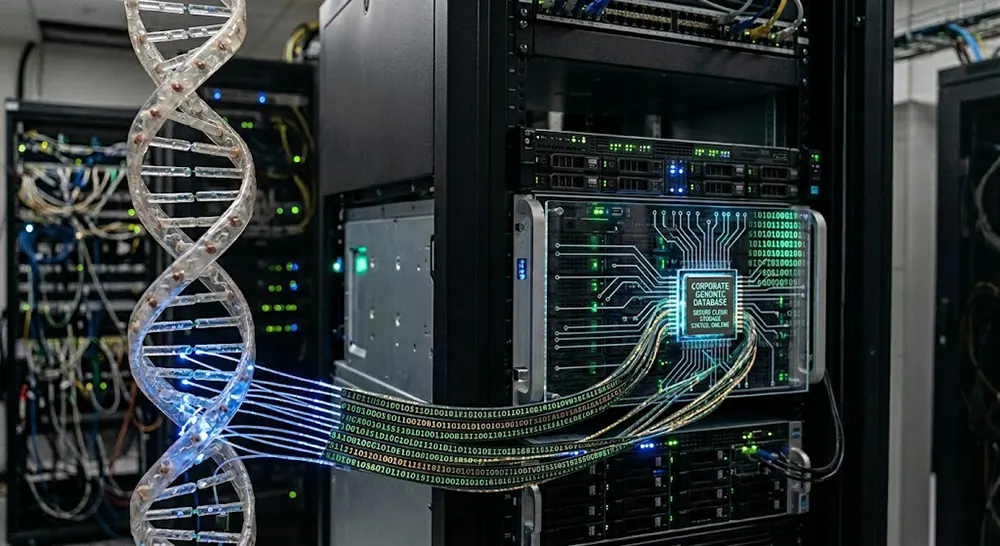
TThe ultimate data breach didn’t involve your credit card number, your social security code, or a compromised corporate email password. It involved your biological blueprint. As the corporate structures of major consumer genetic testing firms fracture under financial instability and regulatory scrutiny in 2026, millions of consumers have woken up to a terrifying reality: you can change a hacked password, but you can never rotate your genetic sequence. Once your genomic data is leaked, it remains compromised permanently. If you want to take back control of your biological identity from predatory data brokers, understanding how to privatize your DNA is no longer a niche obsession for fringe cypherpunks—it is a mandatory operational security requirement for digital survival.
The commodification of human data has reached its logical, dystopian conclusion. Your genetic markers, once treated as highly confidential medical secrets, are now liquid assets traded on corporate balance sheets, targeted by sophisticated cyber-criminal syndicates, and quietly accessed by law enforcement agencies without explicit warrants. The collapse of consumer trust in direct-to-consumer (DTC) genetic apps has exposed a massive regulatory vacuum. Therefore, learning how to privatize your DNA must be treated as your primary line of defense. When a company holding the genetic profiles of thirty million individuals faces bankruptcy or restructuring, those profiles are treated as intellectual property assets to be auctioned off to the highest bidder, completely bypassing the spirit of initial privacy agreements.
The permanent risk profile of biological exposure requires an immediate, systemic change in how we perceive personal telemetry. When an adversary gains access to your raw genomic file, they possess a permanent decryption key to your physical vulnerabilities, ancestral lineage, and hereditary traits. This data does not decay over time. To insulate your family and yourself from this cross-generational liability, you must adopt an adversarial posture toward the entire consumer biotech industry.
The Bio-Privacy Crisis: Why Genetic Data is the New Gold Mine
To understand why Silicon Valley elites and health-tech conglomerates are obsessed with aggregating saliva samples, one must realize that your genome is the ultimate immutable dataset. Traditional consumer profiles tracking your browsing history, purchasing behavior, and geolocations grow stale within a few years. Your DNA, conversely, remains a fixed, unalterable map of your entire existence. It is a gold mine for predictive analytics, health insurance risk profiling, and targeted pharmaceuticals.
When you mail a cheek swab to a consumer-grade app, you aren’t simply purchasing a novel report on your ancestral origins or your caffeine metabolism. You are donating your most intimate intellectual property to a private enterprise. In the modern data ecosystem, these consumer-facing companies frequently pivot from direct sales to acting as specialized research hubs. Your genetic information is aggregated, stripped of basic identifiers, and licensed out. However, data scientists have repeatedly demonstrated that re-identification attacks can easily reconstruct a person’s real identity by cross-referencing supposedly anonymous genetic files with public voter registries and consumer credit bureaus.
This permanent vulnerability creates a distinct contrast with other emerging technological threats to our privacy. For example, understanding neuro-privacy protection frameworks is vital for safeguarding our dynamic brainwave outputs, but brain signals fluctuate based on consciousness, focus, and environment. Genetic data is fundamentally static. If your genome is leaked, that liability automatically cascades down to your children, your parents, and your grandchildren. This compounding risk underscores why mastering foundational digital hygiene concepts is no longer sufficient; we must treat biological data as an entirely separate tier of high-risk, zero-trust operational security.
How to Privatize Your DNA: 5 Critical Steps for 2026
Navigating this hostile terrain requires an aggressive, hands-on approach to data minimization. If you want to protect your biological sovereignty from the fallout of corporate liquidations and state surveillance, implementing a tactical plan on how to privatize your DNA must become your immediate priority.
1. Exploit the “Right to Be Forgotten” and Demand Data Deletion
The most common misconception among consumer tech users is that hitting “delete account” on a smartphone interface purges their data from corporate ecosystems. It does not. When you close a standard account, your raw genetic sequences often remain siloed within cold-storage backups, long-term analytical databases, or generalized research pools under the fine print of your original user agreement.
To truly scrub your biological footprint, you must explicitly invoke statutory privacy protections, such as the California Consumer Privacy Act (CCPA). Force the platform to execute a comprehensive, verifiable purge of both your digital account data and your physical biospecimen. This is the first practical milestone when figuring out how to privatize your DNA.
Many testing firms retain your physical saliva sample in deep-freeze storage labs for years to facilitate future test iterations unless you formally demand its destruction. You must submit a formal data deletion request through their privacy portal, demand written validation of sample incineration, and cross-verify that your profile has been systematically excised from all internal and external matchmaking directories.
2. Adopt Strict Burner Personas for Future Genetic Testing Apps
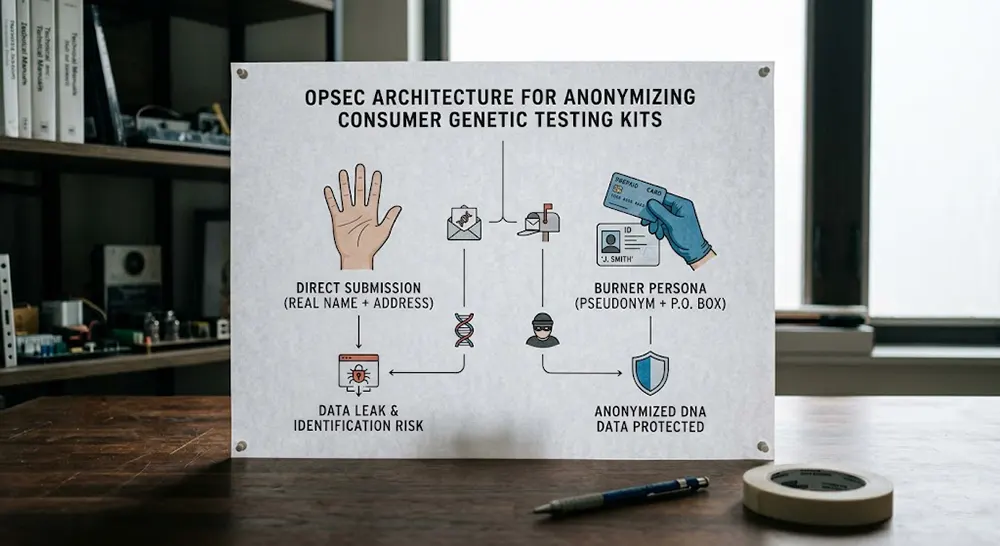
If your medical or diagnostic needs require the use of a consumer-grade health platform, you must never engage with the service using your legal identity. Securing your biological profile relies heavily on using a burner persona, which remains a highly effective method when executing your broader strategy on how to privatize your DNA.
- Pseudonyms Only: Register your account under a completely fabricated name that has zero historical or digital associations with your real life.
- Decoupled Logistics: Utilize a secure Post Office Box, a commercial mail drop, or a remote mail-forwarding service to receive your collection kit. Never have a DNA kit shipped directly to your residential address.
- Financial Anonymity: Purchase testing kits using cash at physical retail storefronts, or utilize masked, single-use privacy credit cards online that are untethered from your primary bank accounts.
- Burner Communications: Register the account using a dedicated, encrypted email address via a privacy-focused provider, accessed exclusively through an anonymized network connection.
By completely separating your biological sample from your legal and digital identity, you ensure that even if the platform suffers a catastrophic server breach, the leaked genome cannot be mapped back to your real-world identity.
3. Opt-Out of Secondary Research and Third-Party Law Enforcement Sharing
By default, almost every consumer testing platform relies on dark patterns to trick users into opting into “secondary research.” This innocent-sounding phrase grants the corporation permission to license your genetic markers to major insurance consortia, academic institutions, and multinational pharmaceutical corporations. If you want to know how to privatize your DNA effectively, cutting off corporate data pipelines is non-negotiable.
Simultaneously, investigative genetic genealogy has become a preferred shortcut for domestic and international law enforcement agencies. Investigators routinely upload crime-scene DNA to public and private matching databases to identify relatives of unidentified suspects. If your relative uploads their data, you are partially exposed; if you upload yours, you compromise your entire extended family tree.
You must dive deep into your account settings immediately. Turn off all secondary research permissions, revoke consent for institutional sharing, opt out of law enforcement matching databases, and set your profile visibility to the absolute highest privacy tier available.
4. Secure Your Digital Access Points with Advanced Defense
The most common vector for a genetic data leak is not a high-level corporate exploit; it is a simple credential-stuffing attack targeting your individual user portal. If you want to secure your accounts, mastering the digital entry points is just as vital as discovering how to privatize your DNA at the source.
Protecting your genetic portal requires hardening the entire digital pipeline surrounding your account. You must implement robust, automated defense measures across all your services. Deploying automated credential rotation mechanisms ensures that your access credentials change dynamically, mitigating the risk of stale password vulnerabilities. Furthermore, anchoring your authentication workflows within post-quantum password vaults guarantees that even if your traffic is intercepted, your keys remain shielded by mathematical models designed to withstand future decryption tools. Combine this with mandatory hardware-based two-factor authentication (2FA) to lock down the digital doorway to your biology.
5. Monitor the Horizon for Corporate Acquisitions and Policy Shifts
A corporate privacy policy is not a static shield; it is a temporary, non-binding declaration that can be rewritten overnight during bankruptcy proceedings, corporate buyouts, or hostile takeovers. Staying vigilant about corporate shifts is a sophisticated aspect of how to privatize your DNA over the long term. When a biotechnology firm faces financial distress, its most liquid and valuable asset is its data repository.
If a company holding your genetic information is acquired by an insurance conglomerate or an aggressive hedge fund, their terms of service will likely pivot to prioritize monetization over consumer protection. You must actively track corporate news regarding any platform you have ever used. The moment a company signals a corporate restructuring, an acquisition, or an adverse change in their data management policies, you must move instantly to pull the plug, delete your records, and rescind your data permissions before ownership changes hands.
The Future of Biometric Security: Zero-Knowledge Genetic Processing
The current centralized architecture of consumer biotechnology is fundamentally broken. Keeping your biological identity secure requires looking toward localized, privacy-preserving cryptographic alternatives. We must transition away from models that require us to send raw, unencrypted DNA files to centralized corporate mainframes. Embracing these advanced cryptographic concepts will redefine how to privatize your DNA in the near future.
Fortunately, the frontier of cryptography offers a glimpse of hope. We are witnessing the rapid expansion of zero-knowledge architecture, a paradigm shift that allows external applications to analyze specific genetic markers and verify health risks without ever seeing, decoding, or storing the raw underlying genome sequence.
Under a zero-knowledge paradigm, your raw genomic sequence stays on your local hardware device, encrypted under your personal cryptographic keys. When an application needs to verify if you have a specific genetic predisposition, it submits a query, and your device generates a mathematical proof that answers the question with a simple “yes” or “no.” The raw data never leaves your possession. Until these decentralized, zero-knowledge processing models become the industry standard for consumer diagnostics, the burden of defense falls entirely on the consumer.
Taking Back Control of Your Biological Identity
Your genetic code represents the absolute final boundary of personal sovereignty. Once compromised, it cannot be reset, updated, patched, or replaced. The turbulent post-23andMe era has conclusively demonstrated that entrusting centralized commercial entities with your biological blueprint is a losing wager.
By enforcing strict burner personas, demanding rigorous physical and digital sample deletion, and locking down your authentication pipelines, you convert your genetic data from an exposed corporate asset into a secure, sovereign vault. Once you master how to privatize your DNA, you safely reclaim your biological sovereignty. Protect your biology with the same intensity that you protect your private servers—because your identity depends on it.
Frequently Asked Questions About Genetic Privacy
Can I completely delete my raw genetic data from a testing company’s servers after an account closure?
When you initiate an account closure on a consumer genetic platform, your data is not instantly eradicated from existence. While a standard deletion removes your profile from consumer-facing directories, your raw genomic sequences often persist within cold-storage system backups and historical analytical pipelines. To truly execute a comprehensive purge, you must explicitly demand the physical destruction of your biospecimen (saliva samples) and invoke statutory legal protections like the CCPA to remove your digital record from third-party research data pools. Understanding these deeper layers of data retention is foundational when learning how to privatize your DNA permanently.
How do data brokers re-identify “anonymized” genetic profiles?
Consumer genetic applications frequently defend their data-sharing partnerships by claiming that all outgoing user data is strictly anonymized. However, computational data scientists have repeatedly proven that these protections are easily bypassed through re-identification attacks. By cross-referencing aggregated, anonymous genomic sets with public voter registration databases, consumer credit bureaus, and public ancestry trees, malicious actors or commercial brokers can map specific genetic traits back to a legal identity with staggering accuracy. This systemic flaw makes traditional anonymization unreliable, forcing individuals to find alternative methods to safeguard their biological datasets.
Is utilizing a virtual private network sufficient to keep my genomic assets hidden?
A virtual private network is an essential layer of defensive infrastructure, but it is not a silver bullet for biological sovereignty. If you establish a secure, encrypted tunnel but proceed to log into a diagnostic app using your legal name, real home address, and a personal credit card, the network mask becomes useless against corporate surveillance. To achieve true genetic anonymity, you must combine operational masking protocols—such as pseudonyms and burner payment methods—with underlying technical safeguards. Securing your web traffic at the packet level using next-generation adaptive encryption tools is a vital component of a comprehensive strategy on how to privatize your DNA and shield your biometric telemetry from upstream interception.

Continue Reading
7 Dangerous Shadow IoT Security Risks Hiding in Your Home
Your smart home is only as secure as its weakest link. Shadow IoT—unmanaged devices like smart bulbs or...
Read Insight →The Zero-Knowledge Revolution: How Tech Protects Your Data Without Seeing It
In the past, proving your identity meant giving away your data. Zero-Knowledge Proofs (ZKP) change the game by...
Read Insight →Neuralink and Neurotech Devices: 5 Critical Brainwave Privacy Tips
Are your thoughts truly private? Discover 5 non-negotiable security configurations for Neuralink and Neurotech Devices. Learn how to...
Read Insight →