 By
By 
Imagine showing someone you have the key to a locked room without ever opening the door or letting them see the key itself. In 2026, this isn’t a magician’s trick—it’s high-level mathematics. For decades, the digital world operated on a dangerous trade-off known as the “Data Paradox.” To access services, we had to surrender our data—passwords, Social Security numbers, and biometric scans—to third-party servers.
This created “honeypots” for hackers. If a company stores your password to verify you, that password can be stolen. Zero-Knowledge Proofs (ZKP) represent a revolution in Data Privacy because they allow for verification without vulnerability. As we navigate the complexities of Privacy-Preserving Tech, ZKP stands as the gold standard for keeping our “biological code” and digital identities safe from prying eyes. In this guide, you will learn how cryptography has evolved from hiding messages to proving truths, and why ZKP is the most critical Encryption Standard you’ve likely never seen in action.
Zero-Knowledge Proofs 101: The “Where’s Waldo” Analogy
To understand the mechanics of this shift, we must move away from complex equations and look at a simple childhood game: Where’s Waldo?
Imagine you want to prove to a friend (the Verifier) that you have found Waldo on a crowded page, but you don’t want to show them exactly where he is hidden. You take a giant sheet of cardboard with a tiny hole cut in the center. You slide the book behind the cardboard until Waldo appears in the hole. Your friend now has 100% proof that you found him, but they have “zero knowledge” of his coordinates on the page or what the rest of the map looks like. In cryptography, you are the Prover, and the math is your cardboard.
The Three Pillars of ZKP
For a protocol to be considered a true Zero-Knowledge Proof, it must satisfy three mathematical requirements:
- Completeness: If the statement is true, an honest Prover will always be able to convince an honest Verifier.
- Soundness: If the statement is false, a cheating Prover cannot convince the Verifier (except with an infinitesimally small margin of mathematical error).
- Zero-Knowledge: If the statement is true, the Verifier learns nothing other than the fact that the statement is true.
Expert Tip: Interactive vs. Non-Interactive Early ZKPs required a “back-and-forth” conversation between computers (Interactive). Today, we use zk-SNARKs, which allow for “Non-Interactive” proofs. This means a user can generate a proof once, and anyone can verify it instantly without further communication.
Why ZKP is the Gold Standard for Data Privacy
Traditional security relies on “encryption,” which is essentially a digital lock. But locks require keys, and whoever holds the key—often the service provider—holds the ultimate power. Zero-Knowledge Proofs flip this hierarchy by removing the need for a shared secret.
Eliminating the “Honeypot”
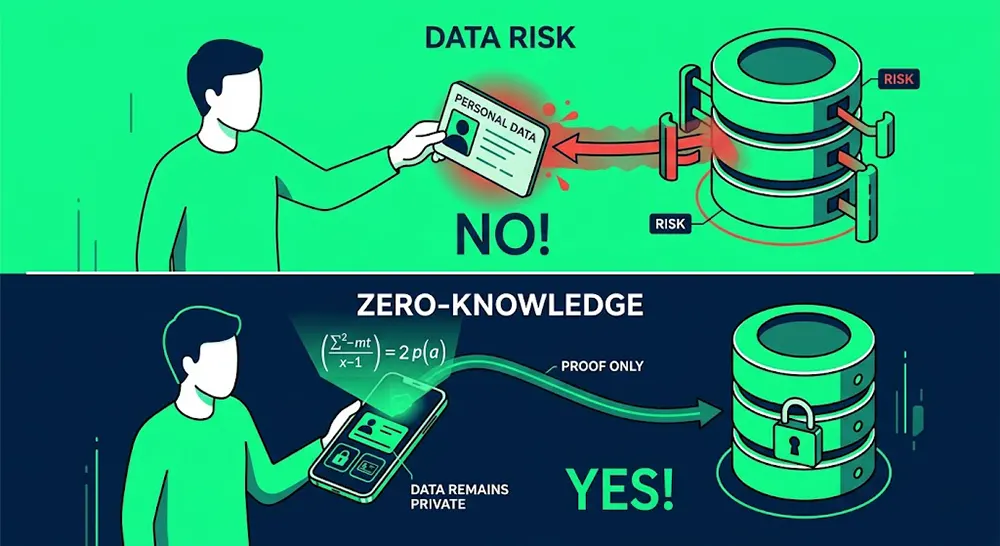
In a standard login system, a server stores a “hash” of your password. If a hacker breaches that server, they can attempt to crack those hashes or use them in “credential stuffing” attacks. With ZKP-based Privacy-Preserving Tech, the server stores nothing but a mathematical “public string.” Since there is no actual data stored on the company’s side, there is no honeypot for a hacker to steal. You prove you know the password without the password ever leaving your device.
Minimizing Data Over-Sharing
Think about buying an age-restricted item or applying for a loan. Currently, you hand over a driver’s license that reveals your full name, home address, and exact date of birth. You only needed to prove you were over 18. ZKP allows your digital wallet to generate a proof that says: “The math confirms this user meets the age requirement,” without revealing a single digit of your birth year. This is the ultimate Encryption Standard for the age of identity theft.
Expert Tip: Selective Disclosure ZKP allows for “Selective Disclosure,” where the user chooses exactly which attributes to prove. You can prove you have a certain credit score range without revealing your bank balance or Social Security number.
Real-World Applications in 2026
By 2026, ZKP has moved out of academic papers and into the hardware of our everyday devices, fundamentally changing how we interact with the web.

Secure Authentication & Passkeys
The era of the traditional password is officially over. Modern Passkeys now utilize ZKP to ensure that your local device handles the biometric “secret,” while the website only receives a cryptographic proof that the check was successful. Your fingerprint or face scan never reaches the cloud, keeping your “biological code” under your exclusive control.
Blockchain & Finance: Privacy on Public Ledgers
On legacy public blockchains, every transaction was visible to the world. However, in 2026, Layer 2 solutions like ZK-Rollups bundle thousands of private transactions into a single proof. This allows for total financial privacy on a public ledger—you can prove you have the funds for a transaction or that you’ve paid your taxes without exposing your entire transaction history to the public.
Identity Verification (DID) and Neurotech
Decentralized Identity (DID) systems are now the standard for applying for jobs or loans. Instead of sending a PDF of your degree or passport, you send a ZK-proof verified by the issuing institution. Furthermore, as brain-computer interfaces (BCI) enter the consumer market, ZKP ensures that an app can “know” you are giving a mental command without ever “seeing” the raw electrical signals of your thoughts.
ZKP vs. Traditional Encryption Standards
It is a common misconception in the Cryptography 101 world that ZKP is simply “better encryption.” In reality, they are two different tools in the cybersecurity shed. While traditional encryption hides the content of a message, ZKP proves something about that content without the verifier ever seeing it.
The Logic of Proof vs. Privacy
Traditional Encryption Standards like AES-256 function like a high-security safe. To see what’s inside, you must have the key. If you share that key with a third party to verify your data, you have expanded your “attack surface.”
Zero-Knowledge Proofs operate differently. They don’t just lock the data; they provide a mathematical “certificate” of its properties.
| Feature | Traditional Encryption | Zero-Knowledge Proofs (ZKP) |
| Primary Goal | Confidentiality (Hiding data) | Verifiability (Proving data facts) |
| Data Exposure | Requires sharing a key to verify. | No data or keys are ever shared. |
| Storage Risk | Servers store “encrypted” data (Honeypots). | Servers store “proofs” (No raw data). |
| 2026 Performance | Microseconds (Standard). | Milliseconds (Powered by ZK-chips). |
Synergy: A Zero-Trust Environment
In 2026, these technologies are no longer rivals; they are partners. A modern Privacy-Preserving Tech stack uses encryption to keep your data private on your own device, while using ZKP to communicate with the outside world. This creates a “Zero-Trust” environment where no service provider ever needs to “hold the keys” to your digital life.
Conclusion: A Future Built on Trustless Trust
The Zero-Knowledge Revolution is shifting the power dynamic of the internet back to the individual. For decades, we operated under the “Trust us” model—trusting banks with our balances, governments with our IDs, and tech giants with our biometrics.
In 2026, we are moving toward “Trustless Trust.” We no longer need to believe a company’s promise to keep our data safe because, thanks to ZKP, they don’t have our data in the first place. They have moving math, not stagnant databases.
The foundation of the next decade of cyber security isn’t just better firewalls; it’s the elimination of the need for them. By proving who we are without revealing what we are, we are finally reclaiming our digital sovereignty.
Deep Dive: Common Questions About Zero-Knowledge Proofs
Is Zero-Knowledge Proof the same as Zero-Trust?
No. Zero-Trust is a security architecture based on the principle of “never trust, always verify.” Zero-Knowledge Proof (ZKP) is one of the primary technologies used to perform that verification without exposing sensitive information.
Can ZKP be hacked?
The mathematical foundations of ZKP (specifically zk-STARKs) are considered “Quantum-Resistant” in 2026. While the math itself is virtually unbreakable, the implementation (the software code) can still have bugs. Security on OnlineShieldHub always emphasizes that the protocol is only as strong as its weakest line of code.
Is ZKP only for Crypto?
Absolutely not. While it gained popularity in blockchain, ZKP is now widely used in Healthcare (verifying insurance without sharing medical history), Legal systems (auditing records without exposing clients), and Web Security (logging in without passwords via Passkeys).
Does ZKP require a lot of computing power?
This was a major hurdle in the early 2020s. However, the 2026 update on SNARKs and STARKs efficiency—combined with specialized hardware acceleration in modern mobile chips—means generating a proof now takes less than 100 milliseconds, roughly the same time it takes to scan your face for FaceID.
Exactly what I was searching for, regards for posting.
Thanks for reading! We’re thrilled the article was exactly what you were looking for. Stay tuned for more insights on privacy, security, and emerging technologies.