 By
By 
The smartphone in your pocket has undergone a fundamental transformation. What was once a communication device is now an active participant in your life, fueled by AI agents that predict your needs, monitor your biometrics, and analyze your environment in real-time. For the average consumer, this is sold as “convenience.” For the privacy-conscious user at OnlineShieldHub, it is a glaring vulnerability.
We have entered an era where standard flagships function as perpetual sensor arrays, training proprietary models on the most intimate details of your daily routine. Moving beyond simple “Incognito mode” or basic app permissions is no longer enough to secure your digital presence. To truly safeguard your identity, you must look at the foundation of the device itself—the hardware and the kernel—rather than just the software interfaces layered on top. This isn’t just about deleting a few apps; it’s about moving toward a hardware-first security model that treats your data as your own, not as raw material for AI training.
Hardware-Level Security: The Foundation of a Privacy-First Smartphone 2026
True privacy begins where software ends—at the silicon. In an age where firmware vulnerabilities are increasingly exploited by sophisticated actors, you cannot rely solely on the operating system to protect your data. Your next device must be built on a foundation of verifiable, physical integrity.
Physical Kill Switches: Your Ultimate Defense Against Surveillance
The most effective way to guarantee privacy is through physical disconnection. If you want to be certain that your microphone, camera, or Wi-Fi radio is off, software “permissions” are simply not enough. In 2026, physical kill switches have become the gold standard for secure mobile hardware. By manually cutting the power to these sensors, you ensure that even if your kernel is compromised, no unauthorized entity can observe your surroundings or listen to your conversations.
Secure Elements (SE) & Hardware Integrity: Protecting Data at the Silicon Level
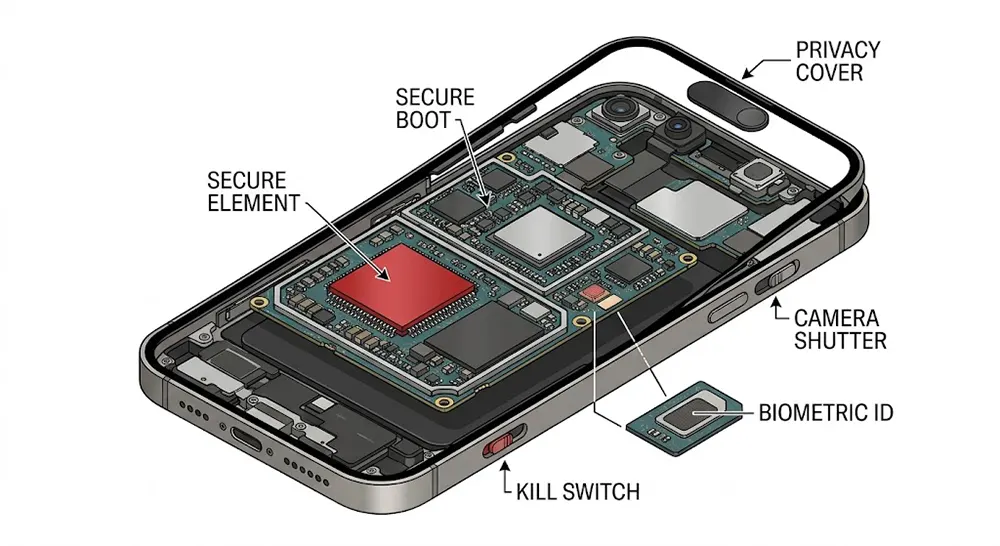
Look for devices that utilize independent Secure Elements (SE), such as the Titan M-series or equivalent open-source modules. These chips act as a dedicated digital vault, isolating your most sensitive cryptographic keys from the main processor. By keeping these keys within a hardware-isolated environment, you ensure that they never touch the system RAM, protecting you from sophisticated memory-scraping attacks.
Replaceable Components: Why Modular Design Matters for Security
Modern “glass-sandwich” designs are built for aesthetics, not security or longevity. For a privacy-first user, a user-replaceable battery is a critical security feature; it allows you to perform a true “hard reboot” by removing the power source entirely, preventing persistent state tracking. Similarly, removable storage with hardware-level encryption is far superior to relying on Cloud Storage, where your data is inherently accessible to service providers and potentially subject to legal subpoenas.
Expert Tip: To ensure your physical hardware is protected against advanced threats, check out our Tactical Armory reviews, where we analyze devices that support post-quantum encryption standards.
The Best De-Googled OS for Your Privacy-First Smartphone 2026
When the hardware foundation is secure, the operating system becomes your primary tool for data sovereignty. Standard Android and iOS are deeply integrated with proprietary telemetry services—effectively turning your device into a data-collection node for the manufacturer. For a truly Privacy-First Smartphone 2026, you need to divorce your mobile experience from these ecosystems.
Top Hardened Mobile OS: GrapheneOS, CalyxOS, and Linux Mobile Alternatives
A de-Googled OS removes the background “phoning home” that plagues modern mobile devices. By replacing Google Play Services with open-source alternatives, you gain granular control over what information leaves your device.
- GrapheneOS: Currently the industry benchmark for Hardened Android. It features advanced sandboxing, improved memory management, and specialized compiler toolchains that make exploitation significantly more difficult for attackers.
- CalyxOS: An excellent choice for users who need a balance between high-level privacy and daily usability. It includes built-in, pre-configured tools for encrypted messaging and firewall management.
- Linux Mobile (PostmarketOS/Phosh): For power users who demand 100% control, Linux-based mobile OSs offer kernel-level transparency. These are essential for those building a Cyber Resilience Strategy that avoids proprietary mobile stacks entirely.

Biometrics vs. PINs: Hardening Your Privacy-First Smartphone 2026
In an era of ubiquitous AI-driven surveillance, the way you unlock your phone has massive implications for your personal safety and legal protection.
The Biometric Coercion Trap: Why Your Face is Not a Secure Password
While FaceID and fingerprint scanners are convenient, they are legally vulnerable. In many jurisdictions, biometric data can be compelled under legal coercion. If your face is the key, your “consent” to unlock your device is largely theoretical. Relying exclusively on biometrics is a significant risk for anyone operating under a high-threat model.
Advanced Passcodes & Anti-Forensics: Strategies for Total Data Protection
For 2026, the safest approach is to utilize long, complex alphanumeric passcodes. When configured correctly, these provide a mathematical barrier that is virtually impossible for law enforcement or malicious actors to bypass through brute force.
- Auto-Wipe Mechanisms: Always ensure your device is configured to trigger a full data wipe after a predefined number of incorrect password attempts. This is your last line of defense against physical theft.
- Privacy Screens: If you operate in public spaces, consider hardware-integrated privacy filters. These screens limit the viewing angle, ensuring that your screen content isn’t being “shoulder-surfed” by AI-powered cameras or curious bystanders.
Expert Tip: For added protection when traveling, complement your device security with Privacy Checklists to ensure your device isn’t broadcasting unnecessary metadata via Bluetooth or Wi-Fi while in public.
Top Recommendations: Choosing the Best Privacy-First Smartphone 2026
When choosing your device, you must balance your technical expertise with your specific security needs. Here are the top contenders that currently set the bar for hardware integrity and OS flexibility.
- The Purism Librem 5 (Version 2026): This remains the gold standard for pure privacy. With physical kill switches for the camera, microphone, and wireless radios, it offers a “no-trust” hardware architecture. It runs PureOS (a Linux derivative), making it the top choice for users who want to avoid the Android kernel entirely.
- PinePhone Pro: Designed specifically for the “tinkerer” and the security-conscious developer. It offers unprecedented access to hardware pins and internal components, allowing you to manually audit the circuitry. It is the premier platform for those building a decentralized cloud setup on the go.
- Google Pixel (The “Irony” Choice): It may seem counterintuitive to buy a device from a major tech giant for privacy, but the Pixel hardware, when paired with GrapheneOS, is arguably the most secure mobile setup available today. The Titan M2 security chip provides hardware-level verified boot and encryption that is difficult to replicate in boutique hardware.
- Punkt MP02 / Minimalist Phones: For those whose threat model prioritizes “digital silence,” these devices provide communication capabilities without the heavy app ecosystem that facilitates tracking. They are the ideal choice for a Digital Disappearance strategy.
The Buyer’s Checklist: 5 Questions Before Purchasing a Privacy-First Smartphone 2026
Before finalizing your purchase, treat your smartphone selection like a critical business procurement. Use this checklist to filter out devices that compromise your security.
- Does it have an unlockable bootloader? Without this, you are locked into the manufacturer’s OS, preventing you from installing privacy-hardened alternatives like GrapheneOS.
- What is the firmware update lifecycle? A secure phone is only secure if it receives regular, timely patches. Avoid manufacturers with a history of “abandoning” models after 1–2 years.
- Are there physical hardware cut-offs? Does the device allow you to physically sever power to sensors, or are you relying solely on software “toggles” that can be bypassed by malware?
- Is the hardware open-source? Can the circuit board and firmware be audited by the community? Proprietary “black box” hardware is a major risk in a high-security environment.
- Does it support localized AI? Ensure the hardware has a NPU (Neural Processing Unit) capable of running Private LLMs locally, keeping your sensitive prompts and data off external cloud servers.
Expert Tip: If you are unsure about a specific manufacturer’s track record, consult our Buying Advice section to see our latest analysis of mobile vendor security policies.
Reclaiming Digital Sovereignty with a Privacy-First Smartphone 2026
The quest for the ultimate privacy-first smartphone is not about achieving 100% anonymity—which is a myth in a hyper-connected world—but about aligning your hardware with your specific threat model. In 2026, technology is designed to make you the product; by choosing a device that grants you control over your hardware, bootloader, and data flow, you are actively opting out of that system.
Do not be swayed by “feature-rich” marketing that prioritizes convenience over your digital rights. A truly secure device is one you can trust because you understand its limitations and have the power to shut it down when needed. Remember: “Don’t buy a phone just because it’s shiny; buy it because you have the power to turn it off completely.” If you are just beginning your journey into digital independence, start small with our Cybersecurity 101 guide to understand the basics of protecting your traffic and data.
Frequently Asked Questions: Privacy-First Smartphone 2026 Buying Guide
1. Can I make an iPhone privacy-friendly? While you can significantly harden iOS by disabling personalized ads, iCloud syncing, and Siri, you remain tethered to Apple’s proprietary ecosystem. If you require absolute transparency, switching to a de-Googled OS on open-source hardware is the only path to true sovereignty.
2. Is GrapheneOS better than standard Android? Yes. GrapheneOS is not just a “skin”; it is a heavily modified Android-compatible OS that introduces fundamental security changes, including advanced sandboxing, improved memory sanity, and the removal of Google’s pervasive telemetry services.
3. Do privacy phones work with 5G/6G? Yes, these phones connect to modern cellular networks perfectly. However, be aware that carrier-level tracking (cell tower triangulation) is a reality. For maximum protection, always route your traffic through a trusted VPN for mobile to prevent your ISP from mapping your activity.
4. Are privacy phones expensive? They can be a larger upfront investment, but they are often more durable and receive longer software support than mainstream flagships. Think of it as a long-term investment in your Digital Resilience rather than a disposable consumer electronics purchase.
Continue Reading
Resilience Over Prevention: Why You Should Buy Security for Recovery, Not Just Defense
In 2026, the "bulletproof" security myth is dead. With AI-driven threats bypassing traditional defenses, the smartest investment for...
Read Insight →