 By
By 
While world leaders and tech titans convened in high-security chambers this month, the ripples of the Global Cyber-Security Summit 2026 will be felt at your kitchen table. The decisions made here determine how you log into your savings account and, more pivotally, who legally owns your digital likeness. The digital landscape has undergone a violent shift. We have moved past the era of individual hackers; in 2026, we are facing AI-Automated Warfare where cyber-attacks are launched by autonomous agents capable of pivoting strategies in milliseconds. At OnlineShieldHub, we’ve distilled over 50 hours of dense policy debate into actionable takeaways to help you navigate this new frontier.
The Rise of “Hyper-Personalized” AI Phishing
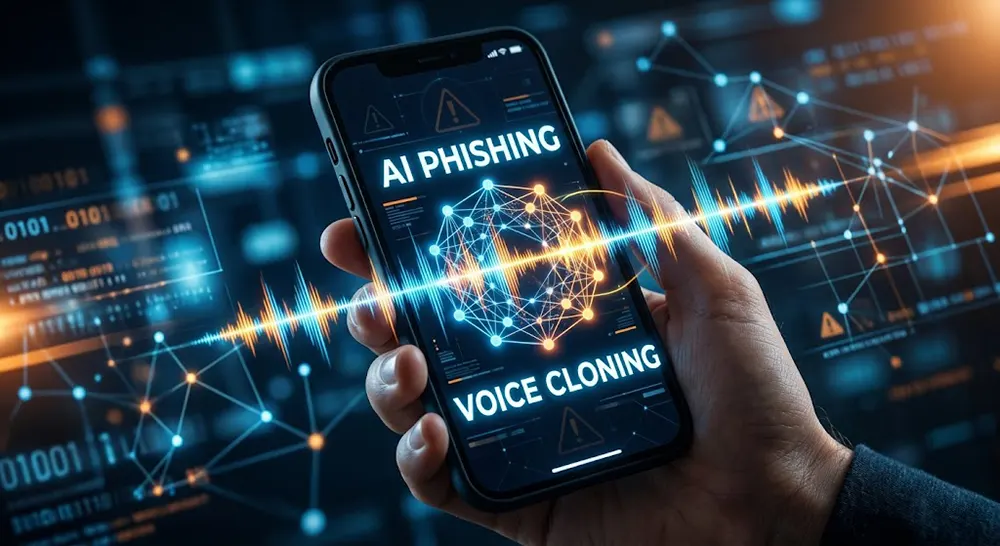
A primary focal point of the Summit was the “LLM Weaponization” report. Large Language Models (LLMs) have evolved to a point where they can generate deepfake voice and video in real-time. This isn’t just about fake celebrity videos anymore; it’s about bypassing traditional Two-Factor Authentication (2FA) through psychological and technical mimicry.
Your “Mother’s Voice” Might Be a Bot
Imagine receiving a call from your child or parent in distress. The voice is perfect—the cadence, the emotional cracks, even the background noise of their favorite coffee shop. They ask for an urgent wire transfer or a login code. At the Summit, researchers demonstrated that a 3-second clip from a social media story is now enough for an AI to clone a voice with 99% accuracy in 2026. This “Hyper-Personalization” makes traditional phishing look like child’s play.
💡 Expert Tip: The Analog Fail-Safe
In a world of digital perfection, go analog. Establish a “Family Emergency Code”—a unique, non-guessable word or phrase (e.g., “Neon Pineapple”) that every family member must say to verify their identity during a suspicious or urgent call. If the caller can’t provide it, hang up immediately.
The Move Towards “Passwordless” Everything
The Summit made one thing clear: the global push to “kill the password” is on track for its 2027 completion target. The highlight of the infrastructure track was the formal introduction of the Universal Passkey 2.0 standard. This protocol isn’t just an upgrade; it’s a fundamental architectural shift in how humans interact with the web.

Passwords are Now the Weakest Link
In 2026, 80% of data breaches still involve compromised credentials. Passkeys replace the “something you know” (a password) with “something you have” (your device) and “something you are” (biometrics). Because a passkey consists of a private key stored locally on your device and a public key on the website’s server, there is nothing for a hacker to steal in a server-side breach.
The Reality of the 2026 Transition:
- Phishing Resistance: A fake website cannot “ask” for a passkey; the cryptographic handshake only happens with the legitimate domain.
- Cross-Platform Harmony: Universal Passkey 2.0 allows you to use your Android phone to log into a MacBook or a Windows PC seamlessly via proximity-based Bluetooth handshakes.
💡 Expert Tip: The 2026 Gold Standard
While software passkeys are highly secure, Hardware Security Keys (like the YubiKey 6 Series) remain the ultimate defense. They provide a physical air-gap that even the most sophisticated AI-driven malware cannot bridge. If you handle cryptocurrency or sensitive work data, a physical key is your best insurance policy.
Quantum-Ready Privacy: Is Your Encryption Obsolete?
One of the most sobering discussions at the Summit involved “Harvest Now, Decrypt Later” (HNDL). Intelligence agencies and state actors are currently intercepting and storing massive amounts of encrypted data that they cannot read today. They are waiting for the “Quantum Dawn”—the point where quantum computers become powerful enough to crack current RSA and ECC encryption standards.
Why Your Current VPN Might Not Be Enough
If you are using standard encryption for long-term data storage or sensitive messaging, that data is essentially a “time capsule” for future hackers. The Summit emphasized that for everyday users, the window to switch to Post-Quantum Cryptography (PQC) is closing. By the time quantum computers are commercially viable, it will be too late to protect the data you are sending now.
Key PQC Implementations to Adopt Immediately:
- Messaging: Ensure your messaging apps (like Signal) have the latest PQXDH protocol enabled.
- Storage: Transition sensitive files to cloud providers that utilize “Lattice-based” encryption.
- Connectivity: Prioritize 2026 VPN standards that offer “Quantum-Resistant Tunnels” to prevent metadata harvesting.
💡 Expert Tip: The PQC Audit
Check your most-used apps for a “Post-Quantum” or “Experimental Security” toggle in the settings. Most major tech companies began rolling these out in late 2025, but they often require manual activation on older accounts.
Digital Sovereignty: Own Your ID, Not the Platform
A recurring theme at the 2026 Summit was the shift toward Decentralized Identifiers (DIDs). For the last decade, we have relied on “Big Tech” logins (Google, Facebook, Apple) to access the web. While convenient, this creates a “honey pot” of personal data and gives platforms the power to revoke your digital existence at will.
Proving Your Identity Without Sharing Your Data
The Summit introduced a new paradigm: the ability to prove who you are without revealing unnecessary details. This is made possible through Zero-Knowledge Proofs (ZKP). In 2026, you should be able to prove to a website that you are over 21 years old without revealing your actual birthdate, or prove your residency without sharing your home address.
How DIDs Change Your Daily Browsing:
- Self-Sovereignty: You own the “root” of your identity on a decentralized ledger; no corporation can delete your account.
- Selective Disclosure: You decide exactly which “claims” (age, nationality, credit score) to share with a specific service.
- Interoperability: One DID wallet works across government portals, banks, and social media, eliminating the need for 100+ different usernames.
💡 Expert Tip: Exploring ZKP Wallets
Download a W3C-compliant DID Wallet (such as the latest versions of Dock or Microsoft Entra). These apps allow you to store “Verifiable Credentials”—digital, cryptographically signed versions of your passport or degree—that you can share securely with third parties without ever sending a photocopied ID.
The “Right to Repair” vs. “Security Updates”
One of the most practical legislative victories discussed at the Summit was the convergence of the “Right to Repair” and mandatory “Security Update Lifecycles.” For years, smart homes have been a security nightmare because manufacturers would stop supporting devices just three years after launch, turning expensive appliances into vulnerable “zombies.”
The 10-Year Security Guarantee
New regulations starting in mid-2026 (led by the EU’s Cyber Resilience Act and mirrored by US standards) now require IoT manufacturers to provide security patches for the “expected lifespan” of the product—often up to 10 years. This means your “Smart Fridge” or “Smart Lock” won’t become an entry point for a botnet just because it’s no longer the newest model on the shelf.
What to Look for When Buying in 2026:
- Security Expiry Date: Look for a clear “Support Until” date on the packaging, similar to an expiration date on food.
- Repairability Score: Higher scores often correlate with better modularity, making it easier to replace a compromised Wi-Fi chip without tossing the whole machine.
💡 Expert Tip: The IoT Audit
Before purchasing a new smart appliance, scan the Digital Security Label (QR code). In 2026, reputable manufacturers are required to disclose their vulnerability disclosure policy and the exact month and year that security updates will cease. If the box doesn’t have this, don’t put it on your network.
Conclusion: Resilience is a Personal Habit
The Global Cyber-Security Summit 2026 has drawn a clear line in the sand: governments and tech giants can build the world’s strongest fortifications, but they cannot protect your “digital home” alone. As we move deeper into an era defined by autonomous AI threats and the looming shadow of quantum decryption, security is no longer a background process—it is a shared responsibility.
The “Verdict” from the 2026 Summit is that we are transitioning from a model of passive defense to one of Active Digital Resilience. The tools discussed—from Universal Passkeys to Zero-Knowledge Proof wallets—are powerful, but they require a shift in mindset. We must move away from the “set it and forget it” mentality of the 2010s.
Final Thought: “In 2026, being ‘unhackable’ isn’t about owning the most expensive software; it’s about cultivating the most resilient digital habits.” By staying informed through platforms like OnlineShieldHub, you aren’t just a user—you are a proactive guardian of your own digital future.
FAQ (SEO Snippet & Search Intent)
What was the biggest surprise at the 2026 Global Cyber-Security Summit?
The most significant breakthrough was the “Real-Time AI-Voice Clone” demonstration. Researchers proved that with just a 3-second audio sample from social media, an AI could mimic a person’s voice with 99% accuracy during a live phone call, making “Family Emergency Codes” a mandatory safety measure for 2026.
Do I need a new phone for Post-Quantum security?
Not necessarily for basic protection. Most Post-Quantum Cryptography (PQC) standards, like those used in the latest Signal or Proton updates, are software-based. However, newer devices released in 2026 feature dedicated “Quantum-Enclave” chips that handle these complex mathematical operations more efficiently without draining your battery.
Are passwords officially dead in 2026?
Passwords are in a “sunset phase.” While many legacy websites still offer them, the global standard has shifted to Universal Passkey 2.0. Most major financial and healthcare institutions now require Passkeys or Hardware Security Keys as the primary login method to eliminate the risks of phishing and credential stuffing.
How can I protect my family from deepfake scams?
The most effective defense is a non-digital one: the Secret Word Strategy. Establish a unique, unguessable phrase known only to your inner circle. If a family member calls asking for money or sensitive information, they must provide the code to verify it isn’t an AI-generated clone.